Free browser game · No download
The Unnumbered Room
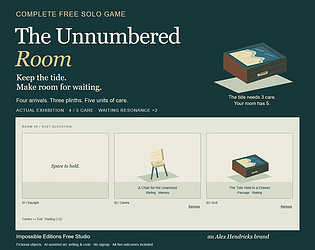
In The Unnumbered Room, arrange unusual museum objects and decide what your limited care makes possible.
ByalexhendricksReleasedLink checked Oct 16, 2026
How to play The Unnumbered Room
- Tab to an arrival, then press Enter or Space to choose it.
- Use the nearby placement controls to arrange up to three objects on Daylight, Centre, or Exit.
- Open the exhibition to read what your choices make possible.
- Press Escape to cancel selection; download a collection save because there is no automatic saving.

Made The Unnumbered Room? Tell us and we will update or remove this page.Contact Us
- Interactive Fiction
- Atmospheric
- choices-matter
- Experimental
- museum
- Relaxing
- Short
- Singleplayer
Play Other Games
See all hot games →




About The Unnumbered Room
About The Unnumbered Room
The Unnumbered Room is a short interactive fiction game about curating a fictional museum exhibition. Created by alexhendricks, it presents four unusual objects and asks you to decide how they should be arranged with limited care. It is a solo, untimed experience with an atmospheric and experimental tone. The game runs in a browser through its itch.io page, and an offline edition is also available.
Gameplay and choices in The Unnumbered Room
In The Unnumbered Room, you work with five units of care and may place up to three of four arriving objects. Choose among Daylight, Centre, and Exit, using the nearby placement controls to shape the exhibition. Once you open it, the arrangement determines what possibilities and endings you can read. There are no timed encounters or combat choices; the main tactic is deciding what to include, where to place it, and what to leave out.
What sets The Unnumbered Room apart
The Unnumbered Room stands out by turning museum curation into a compact choice-driven structure. Its fictional objects, limited care, and three placement areas create a quiet strategic puzzle without conventional combat or character progression. The five endings give each arrangement a clear consequence and invite careful rereading. Its atmospheric, experimental presentation keeps the focus on interpretation, selection, and the meaning created by an exhibition.
Is The Unnumbered Room for you?
The Unnumbered Room suits players who enjoy atmospheric interactive fiction, experimental storytelling, and short sessions with meaningful decisions. Strategy fans may appreciate managing five units of care, while RPG players looking for character builds should expect a different kind of planning. There are no heroes, classes, upgrades, or long-term progression. It is a complete game rather than a demo, but its deliberately brief, single-exhibition format will not suit players seeking a lengthy campaign.
FAQ
The Unnumbered Room FAQ
Is The Unnumbered Room free?
Yes. The Unnumbered Room is free to play, and the complete game includes all five endings. You can use the browser version on itch.io, and an offline edition is also available.
Who made the game?
alexhendricks developed the game under the Impossible Editions Free Studio brand. The project identifies its writing, code, and original procedural vector studies as AI-assisted, with no runtime generative AI.
Can I play the game in my browser?
Yes. The Unnumbered Room runs in your browser through itch.io, and the game itself has no account requirement. An offline edition is available too; itch.io may separately log visits or set cookies.
What kind of game is it?
It is a short, untimed, single-player interactive fiction game set around a museum exhibition. You arrange fictional objects with limited care, then read the possibilities and endings created by that curatorial choice.
Does the game have upgrades or builds?
The Unnumbered Room has no character upgrades, classes, or conventional builds. Its strategic system centers on five units of care and the choice to place up to three objects across Daylight, Centre, and Exit.
Is it a full game or a demo?
It is a complete game, not a demo, and includes all five endings. The scope is intentionally short and focused on one exhibition, rather than a long campaign with extended progression.