Azeroth Survivors Builds: All 9 Classes Side by Side
Updated 2026-11-02
Version game build 3dee002, upstream synced 2026-09-24
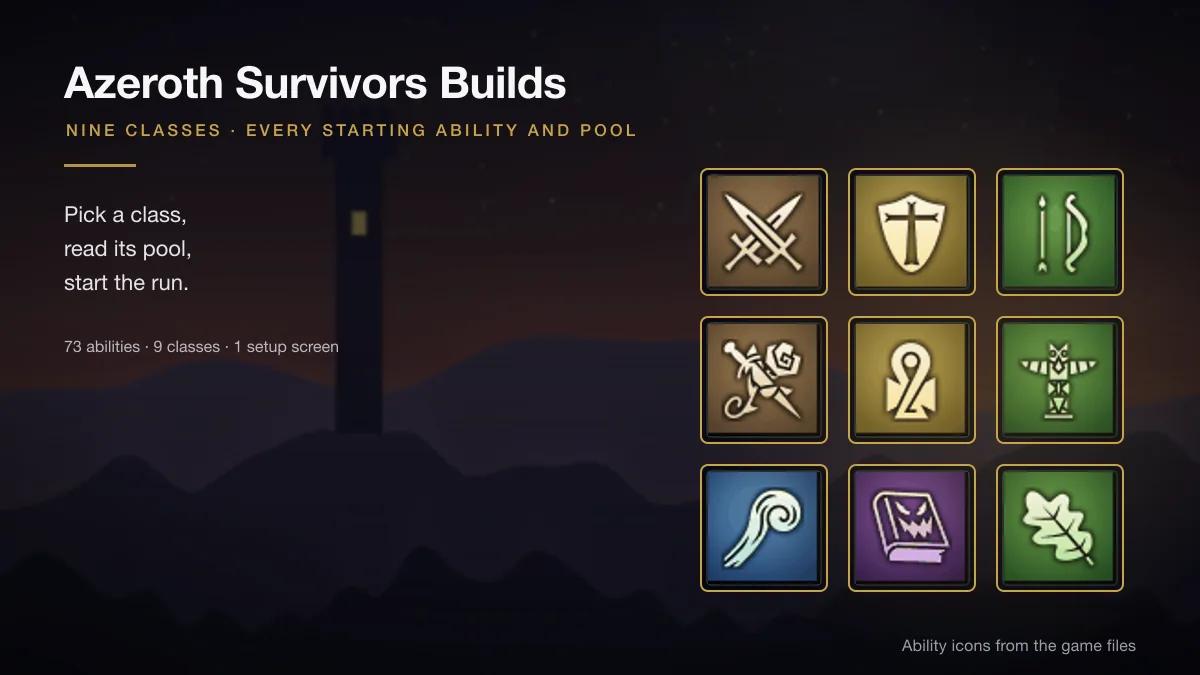
Azeroth Survivors builds come down to nine classes, and each one starts with its own skill and draws upgrades from its own pool. This page puts all nine side by side: starting skill, pool size, power type and the numbers behind the starting skill, taken from the game's own class and ability data.
What do Azeroth Survivors builds look like at a glance?
Every one of the nine Azeroth Survivors builds is one class, one starting skill and one pool of class skills. The table below lists all nine with the numbers that matter before a run: what the class starts with, how big its pool is, which skills sit in that pool and which resource the class table gives it.
| Class | Starting skill | Starting skill type | Class skills in the pool | Pool mix | Power type |
|---|---|---|---|---|---|
| Warrior | Cleave | Melee | 9 | 3 melee, 3 nova, 1 aura, 1 strike, 1 thorns | Rage |
| Paladin | Hammer Of Wrath | Bolt | 8 | 4 strike, 1 bolt, 1 nova, 1 ground self, 1 immune | Mana |
| Hunter | Arcane Shot | Bolt | 7 | 5 bolt, 2 ground | Mana |
| Rogue | Sinister Strike | Melee | 6 | 4 melee, 1 nova, 1 damage over time | Energy |
| Priest | Smite | Strike | 7 | 3 strike, 2 nova, 1 damage over time, 1 shield | Mana |
| Shaman | Lightning Bolt | Bolt | 8 | 3 strike, 2 totem, 1 bolt, 1 chain, 1 orbit | Mana |
| Mage | Frostbolt | Bolt | 11 | 4 bolt, 3 nova, 2 ground, 1 strike, 1 cone | Mana |
| Warlock | Shadow Bolt | Bolt | 9 | 3 strike, 2 bolt, 2 damage over time, 1 ground, 1 aura | Mana |
| Druid | Wrath | Bolt | 8 | 2 strike, 2 damage over time, 1 bolt, 1 ground, 1 thorns, 1 heal | Mana |
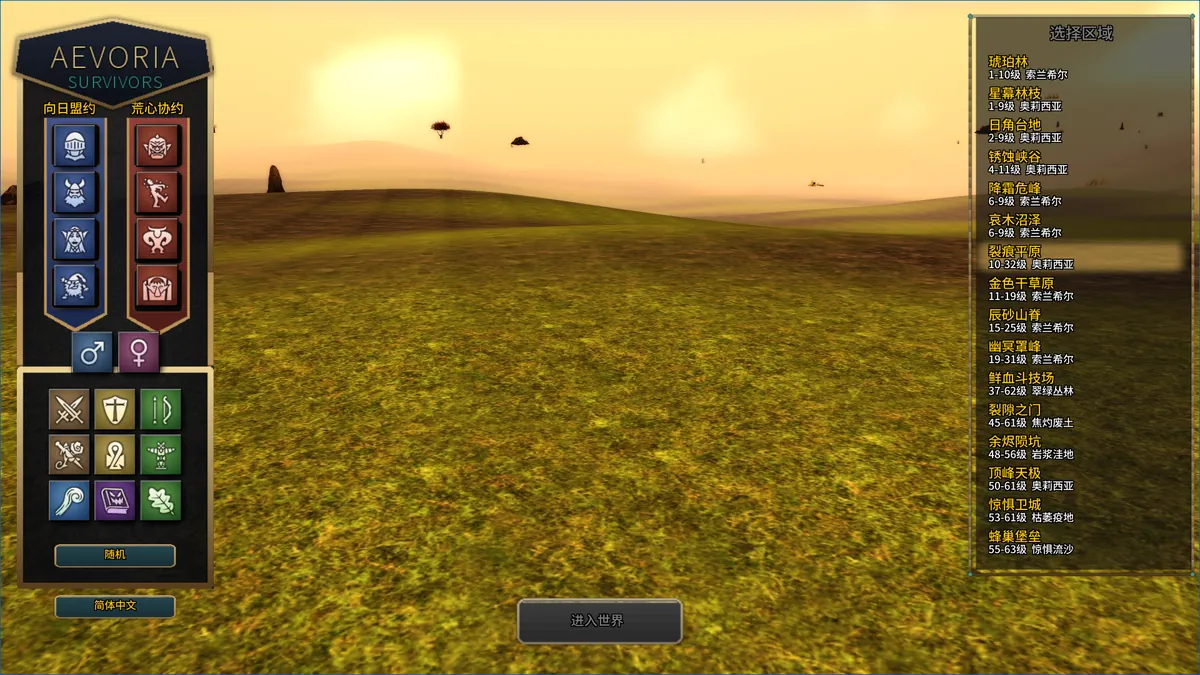
Power type is the resource the class table assigns: Warrior gets rage, Rogue gets energy and the other seven get mana. Nothing in the mode spends that resource, because abilities cast on their own cooldown and cost nothing, so the column reads as a class label rather than a bar you manage.
| How to read this table | Value |
|---|---|
| Classes listed | 9, one row each |
| Counting rule | Pool = the class's own skill list; the starting skill is counted in it |
| Skill types | The kind tag the game gives each skill in that class's list |
| Data version | game build 3dee002, upstream synced 2026-09-24 |
| Last updated | 2026-11-02 |
Each class has its own build page with the full skill list:
- Warrior build: Cleave and 9 class skills.
- Paladin build: Hammer Of Wrath and 8 class skills.
- Hunter build: Arcane Shot and 7 class skills.
- Rogue build: Sinister Strike and 6 class skills.
- Priest build: Smite and 7 class skills.
- Shaman build: Lightning Bolt and 8 class skills.
- Mage build: Frostbolt and 11 class skills.
- Warlock build: Shadow Bolt and 9 class skills.
- Druid build: Wrath and 8 class skills.
For the beginner side of the same choice, read the classes and beginner builds guide; for waves, pickups and the level-up loop, read how to play Azeroth Survivors. Every row in the quick table has a page of its own below it, so the nine Azeroth Survivors builds can be compared one class at a time.
How do you pick your first Azeroth Survivors build?
Pick the class whose starting skill you want to watch for a whole run, then check two numbers: its reach and its pool size. The starting skill is the only ability you own from the first second, so it sets how the opening waves feel, and reach decides whether you stand inside the pack or keep a gap open.
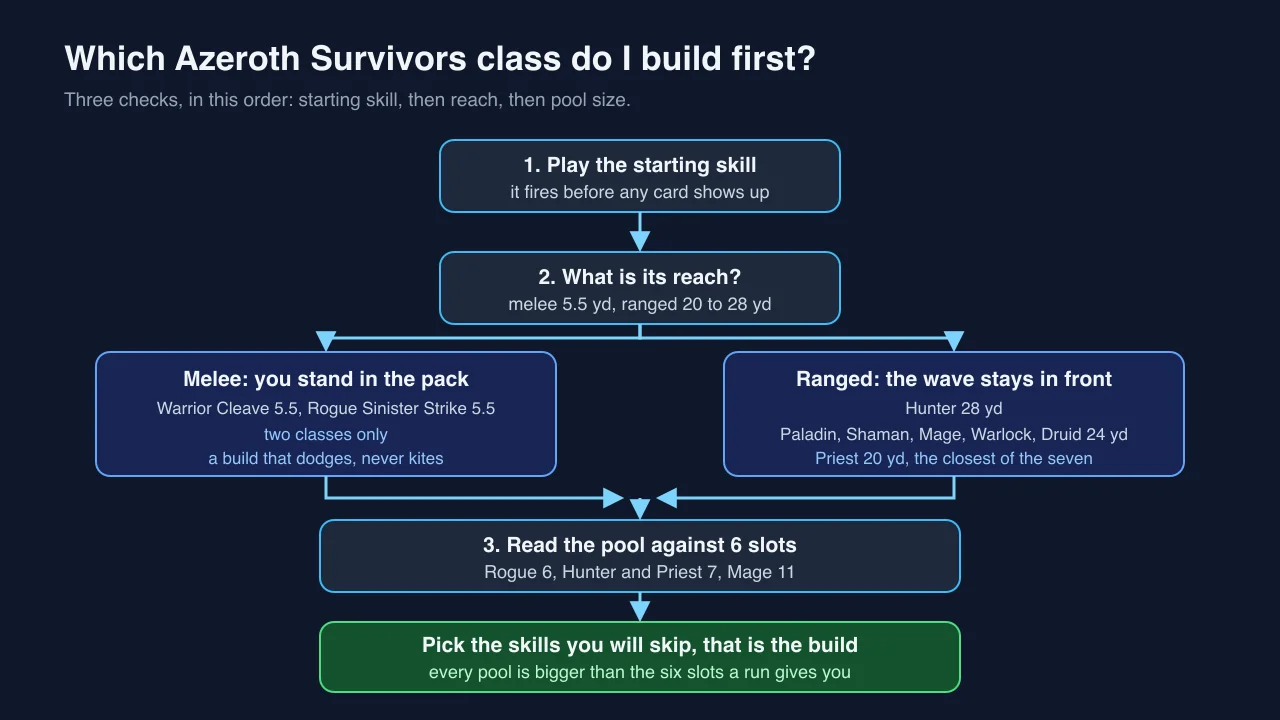
- Play the starting skill first, because it fires before any level-up card appears and it is what clears the opening wave on every class.
- Check the reach next, because Cleave and Sinister Strike hit at 5.5 yards while the ranged starters sit between 20 and 28, and that distance decides where you stand for the rest of the run.
- Count the pool after that, because Rogue offers 6 class skills and Mage offers 11 against the same 6 slots, so a bigger pool means more cards that will not fit any build.
- Decide which skills you will skip before the run, because every pool is larger than the slots a run gives you and a build is defined as much by what it leaves out as by what it takes.
- Stay on the class for five or six runs, because one run only shows part of a pool and the class's shape becomes clear once most of its skills have appeared.
- Note what the run keeps offering, because the offer is drawn from your own pool with a bias toward upgrading skills you already hold, so an early pick keeps coming back.
None of that needs a tier list: the nine Azeroth Survivors builds differ in starting skill, reach and pool size, and all three numbers are printed above, so the pick comes down to which pool you want to learn rather than to which hero looks strongest in someone else's run.
How hard does each class's starting skill hit?
Every class starts with one skill at level 1, and the ability table gives that skill its damage, cooldown, range and target count. Damage is what one cast deals before any passive card, cooldown is how often it fires again, and range is the distance the game checks before the skill picks its target.
| Class | Starting skill | Damage per cast | Cooldown | Range | Targets per cast |
|---|---|---|---|---|---|
| Warrior | Cleave | 14 | 1.1 s | 5.5 yd | 3 |
| Paladin | Hammer Of Wrath | 16 | 1.5 s | 24 yd | 1 |
| Hunter | Arcane Shot | 13 | 1.0 s | 28 yd | 1 |
| Rogue | Sinister Strike | 15 | 0.85 s | 5.5 yd | 1 |
| Priest | Smite | 14 | 1.2 s | 20 yd | 1 |
| Shaman | Lightning Bolt | 15 | 1.3 s | 24 yd | 1 |
| Mage | Frostbolt | 12 | 1.3 s | 24 yd | 1 |
| Warlock | Shadow Bolt | 15 | 1.4 s | 24 yd | 1 |
| Druid | Wrath | 13 | 1.2 s | 24 yd | 1 |
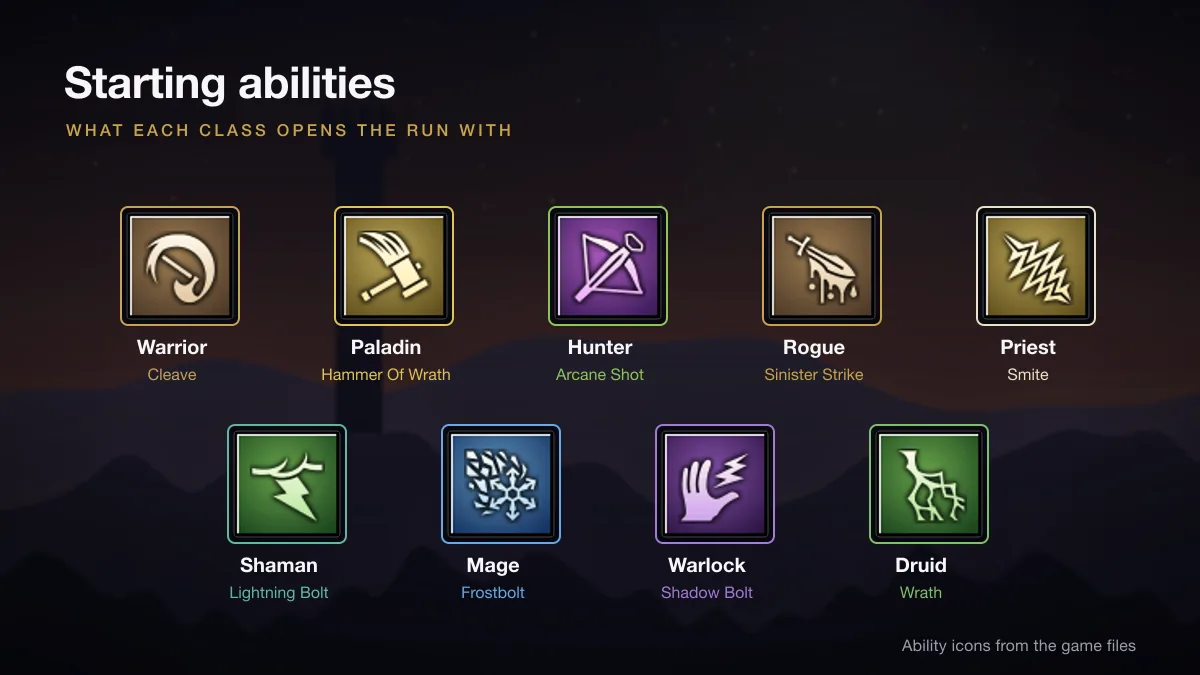
Those are level 1 casts. Every level adds 30% of the base damage, so a level 8 skill deals 3.1 times its base damage, its cooldown shrinks by 7% per level, and it picks up one extra target at levels 3, 5 and 7, which is how a three target Cleave becomes a six target Cleave.
Read the table by role instead of by size, because reach separates Azeroth Survivors builds more than raw damage does. Cleave and Sinister Strike have the shortest reach and the fastest cooldowns, Hammer Of Wrath hits hardest per cast at 16 damage, and Hunter's Arcane Shot trades damage for a 28 yard reach, which is the longest of the nine.
How does an Azeroth Survivors build fill its six skill slots?
A run holds six skills, each skill reaches level 8, and six passives fill the side slots, so a build is a whole-run plan rather than a collection of picks. Each level offers three cards, and the offer weighs them: an upgrade to a skill you already own comes up most often and a brand new passive least often.
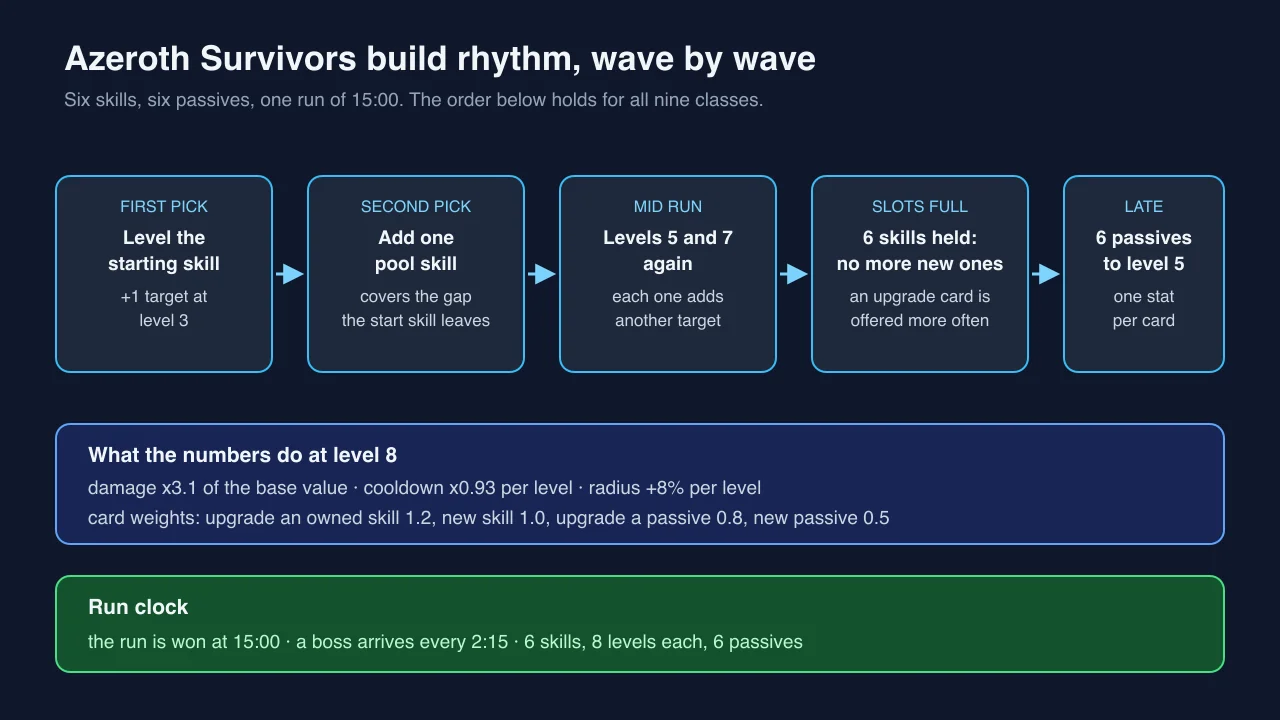
The weight is why an early pick matters more than it looks in Azeroth Survivors builds. Upgrading a skill you hold is offered at weight 1.2, a new class skill at 1.0, a passive upgrade at 0.8 and a new passive at 0.5, so the skill you take on the first card is also the one the game keeps pushing higher.
| Rule | Value |
|---|---|
| Skills held at once | 6 |
| Levels per skill | 8 |
| Passives held at once | 6 |
| Levels per passive | 5 |
| Run clock | 15:00, and the run is won at the clock |
| Boss timer | one boss every 2:15 |
Put together, those numbers describe the shape of every Azeroth Survivors build on this page: two or three skills levelled high, a slot or two for coverage, and passives that scale whatever the class already does well. The pool only decides which six skills are on offer.
Which passives can an Azeroth Survivors build take?
Passives are not split by class in Azeroth Survivors builds. All nine classes draw from the same ten passive cards, hold six of them and level each one to 5, so a Warrior and a Mage are offered the same list. Every card raises one stat by a fixed amount per level, and none of them is class locked.
| Passive card | Stat | What it raises | Per level |
|---|---|---|---|
| Blessing of Might | Might | All damage you deal | +10% |
| Power Word: Fortitude | Max health | Maximum health | +20% |
| Aspect of the Pack | Speed | Movement speed | +10% |
| Renew | Regen | Health restored per second | +0.5 per second |
| Arcane Intellect | Haste | How fast abilities recharge | +8% |
| Amplify Magic | Area | Size of your areas of effect | +10% |
| Detect Lesser Invisibility | Magnet | Pickup range | +40% |
| Blessing of Wisdom | Growth | Experience you gain | +8% |
| Mark of the Wild | Armor | Damage blocked per hit | +1 per hit |
| Blessing of Kings | Crit | Chance to crit for double damage | +5% |
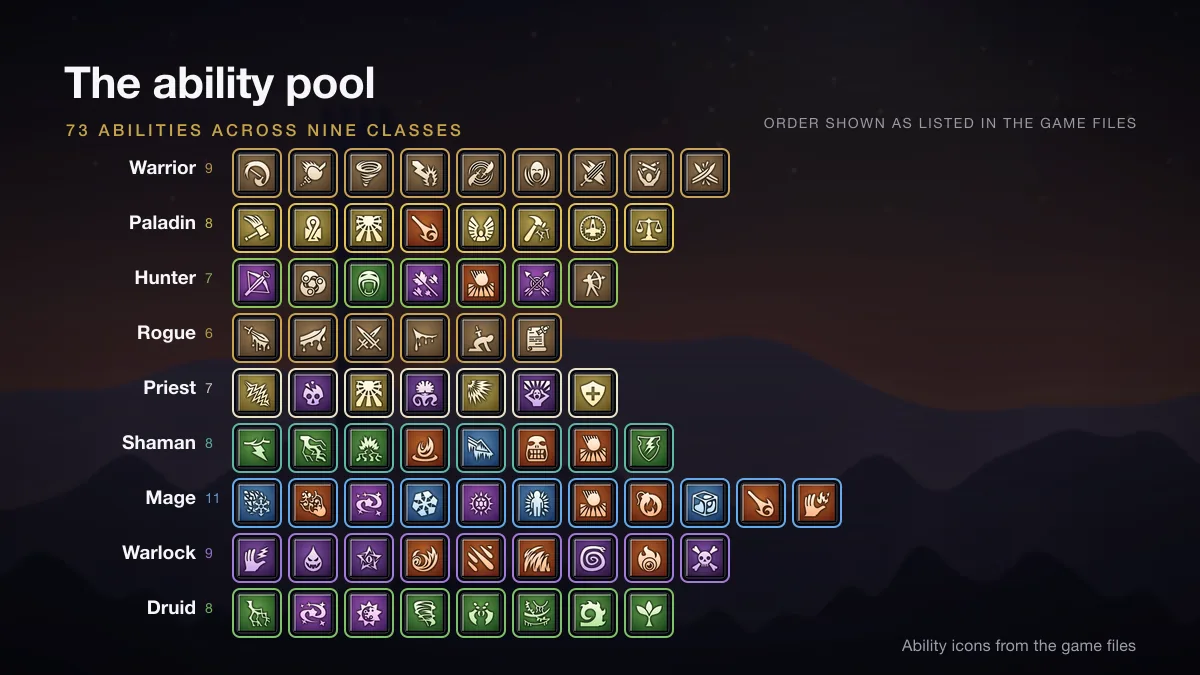
Because the pool is shared by all nine Azeroth Survivors builds, a class never changes which passives you are offered, so the choice is about the stat your run is short of rather than about the hero. Amplify Magic is the card that grows every area and damage-over-time skill in a pool, and Arcane Intellect is the one that makes a whole build fire more often.
What mistakes stall an Azeroth Survivors build?
Most runs end on a build decision rather than on a class being weak, and the same six mistakes show up across Azeroth Survivors builds. Each one wastes a card, a slot or the open space a build needs, and all six can be fixed inside a single run.
- Taking a new skill at every level-up and leaving the starting skill at level 2 or 3, when that first skill is the one the offer keeps upgrading.
- Treating a big pool as an advantage: Mage offers 11 class skills and a run holds 6, so 5 of them will never make the build.
- Filling all six passive slots with level 1 cards instead of levelling the cards already in the build.
- Picking a class for its passive list, when all nine classes are offered the same ten cards.
- Judging a class on one run, when one run only shows part of its pool and the rest never got offered.
- Standing still because the skills aim themselves, when the auto-cast handles aiming and not positioning.
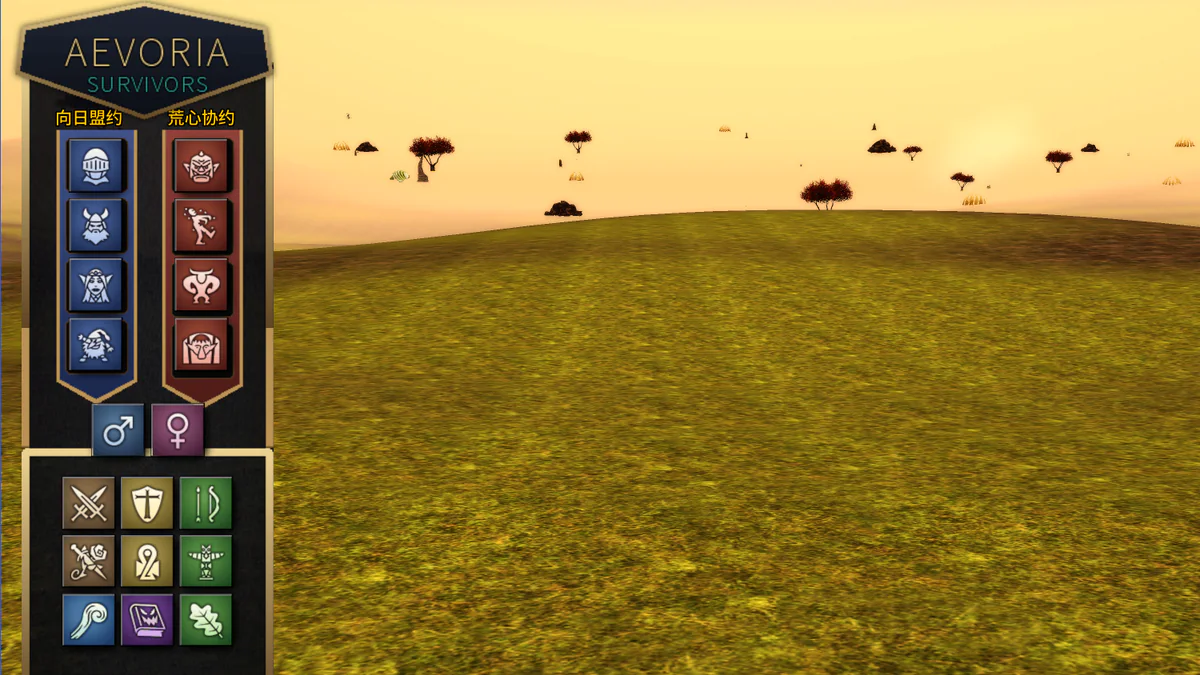
Fixing one of those per run is usually enough for Azeroth Survivors builds to feel different, and it teaches more than switching class does. The class pages list the whole pool, so a second attempt can be planned around the skills the first attempt never got offered.
Azeroth Survivors Builds FAQ
How many Azeroth Survivors builds are there?
There are nine, one per class: Warrior, Paladin, Hunter, Rogue, Priest, Shaman, Mage, Warlock and Druid. Each class has its own starting skill and its own pool of class skills, which runs from 6 on the Rogue to 11 on the Mage.
Which Azeroth Survivors builds are easiest for a first run?
A short pool and a readable starting skill make the opening easier, so Rogue with 6 class skills, then Hunter and Priest with 7, are the gentlest lists to learn. Warrior is still a fine first class, because Cleave hits the three closest enemies in melee reach and shows you spacing from the first second.
Is there one strongest class in Azeroth Survivors builds?
The class data does not rank the nine heroes; it gives each one a starting skill, a pool size and a type mix, and those are the only things that differ between them. What you can compare is reach and pool shape: Rogue leans on 4 melee skills, Hunter leans on 5 bolt skills, and Mage spreads 11 skills across 4 bolts, 3 novas and 2 ground areas.
Can a build hold every skill its class offers?
No. A run holds 6 skills and every pool is bigger than that, which holds for all nine Azeroth Survivors builds: from 6 on the Rogue to 11 on the Mage, so at least one skill is always left out and the Mage leaves out five. Choosing those skills is the build decision, and each class page lists the full pool so the skips can be planned before the run.
How high can one skill go?
Every skill caps at level 8 and every passive at level 5, with six of each held at once. Each level adds 30% of the skill's base damage, so a finished skill deals 3.1 times its base damage, and it gains one extra target at levels 3, 5 and 7.
Do the classes get different passives?
No. Passives come from one shared pool of ten cards, so all nine classes are offered Blessing of Might, Power Word: Fortitude, Amplify Magic and the other seven. You can hold six and level each to 5, which means a passive card is never a reason to pick one class over another.
What order should a new build take its cards in?
Level the starting skill first, then add one skill from the pool that covers what the opener misses, then keep pushing those two or three skills instead of filling all six slots. The offer helps here: it weights an upgrade to a skill you own at 1.2 against a new class skill at 1.0, so the early picks keep coming back.
Why does an Azeroth Survivors build stop killing things late in the run?
Usually because the cards went into too many different skills. A run is won at 15:00 with a boss every 2:15, so late waves need two or three skills at high level plus Amplify Magic for area size and Arcane Intellect for recharge, not six skills at level 1.
Data: the game's own class, ability and passive tables at game build 3dee002 (upstream engine synced 2026-09-24); checked 2026-11-02. Independent guide for Azeroth Survivors builds.
Related builds
More Survivors-like Games


Free in the browser, like the Azeroth Survivors builds guide above.