Azeroth Survivors Druid build
Updated 2026-11-02
Version game build 3dee002, upstream synced 2026-09-24
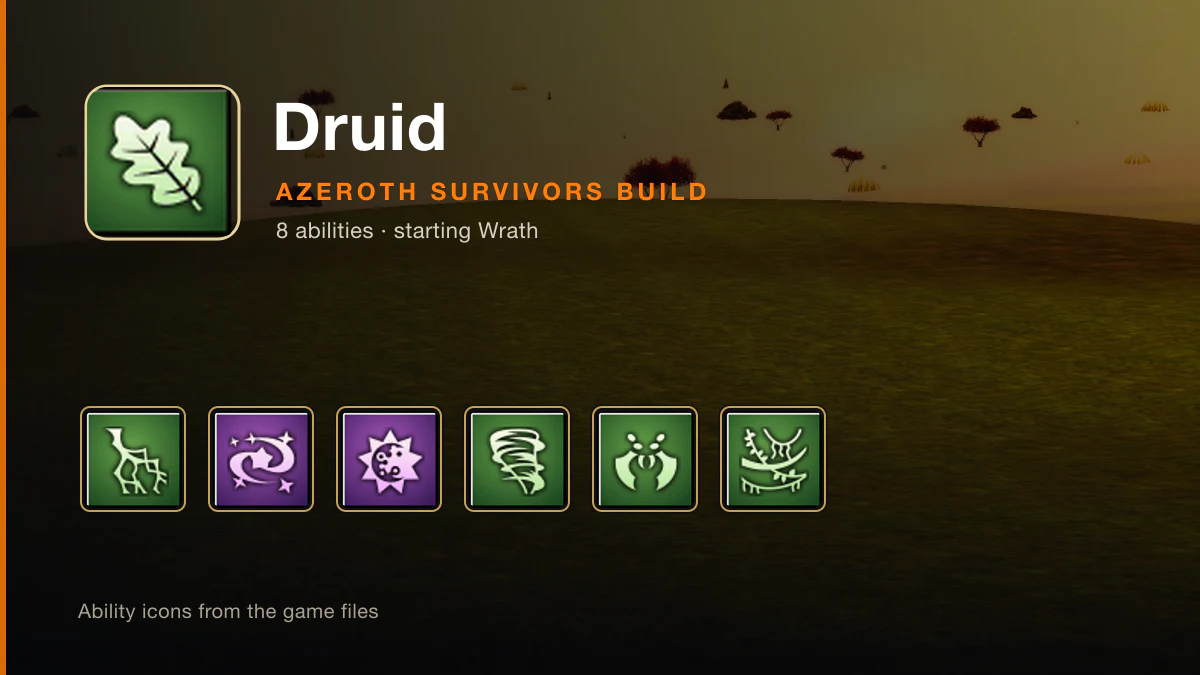
An Azeroth Survivors Druid build starts from Wrath, and the class pool around it holds eight abilities, six slots and eight levels each. Nothing in that pool is melee, so the run is about order and space: Wrath first, Starfire second, Hurricane third, then a damage-over-time pick.
Quick reference for the Azeroth Survivors Druid build:
| Druid at a glance | Value |
|---|---|
| Class | Druid, a warden of the groves tied to the ancient ley mother |
| Starting ability | Wrath (Bolt, 13 damage, 1.2 s cooldown, 24 range) |
| Ability pool | 8 class abilities |
| Ability kinds | 1 Bolt, 2 Strike, 1 Ground, 2 Damage over time, 1 Thorns, 1 Heal |
| Max abilities | 6 held at once |
| Max ability level | 8 |
| Max passives | Drawn from one pool shared by every class |
| Max passive level | 5 |
| Power type | Mana on the class record; the survivor mode runs no mana bar |
| Run length | A long run, with bosses arriving at intervals |
- All nine Azeroth Survivors builds: the same facts for every class, side by side.
- Azeroth Survivors classes: which hero suits a first run.
- How to play Azeroth Survivors: waves, pickups and the level-up loop.
- Azeroth Survivors mobile if you want to run the same build on a phone or tablet.
- Mage build for the other caster pool, and Warrior build for the melee opposite.
Azeroth Survivors Druid build: how the class plays
An Azeroth Survivors Druid build plays at range: eight abilities, no melee swing. The pool holds one bolt, two strikes, one ground area, two damage-over-time picks, one damage reflect and one heal, and every one of them is cast at enemies from a distance. Position decides Druid runs more than reflexes do.
What the game's own class text says
The game describes the Druid as a warden of the groves tuned to the ancient ley mother, driving strangling roots, calling swarms of insects and star-fire punishment, and holding the wild in its order. The ability pool backs that text up line by line: the strangling roots are Entangling Roots, the swarms are Insect Swarm, the star-fire is Starfire and Moonfire, and the stolen order is Hurricane.
Wrath is the whole first minute
Wrath is the only ability you own at level one: a bolt that picks one target at 24 range for 13 damage on a 1.2 second cooldown. That is enough while enemies arrive in a thin line, and it stops being enough the moment they come from two directions, which is the point where your second and third picks decide the run.
Nothing in the pool needs a button press
Every ability casts itself at the targets its kind picks, on its own cooldown, so an Azeroth Survivors Druid build is movement, dodging and card picks. Whatever you take early keeps firing for the rest of the run, whether or not you are looking at it, which is why the order matters more than the reflexes.
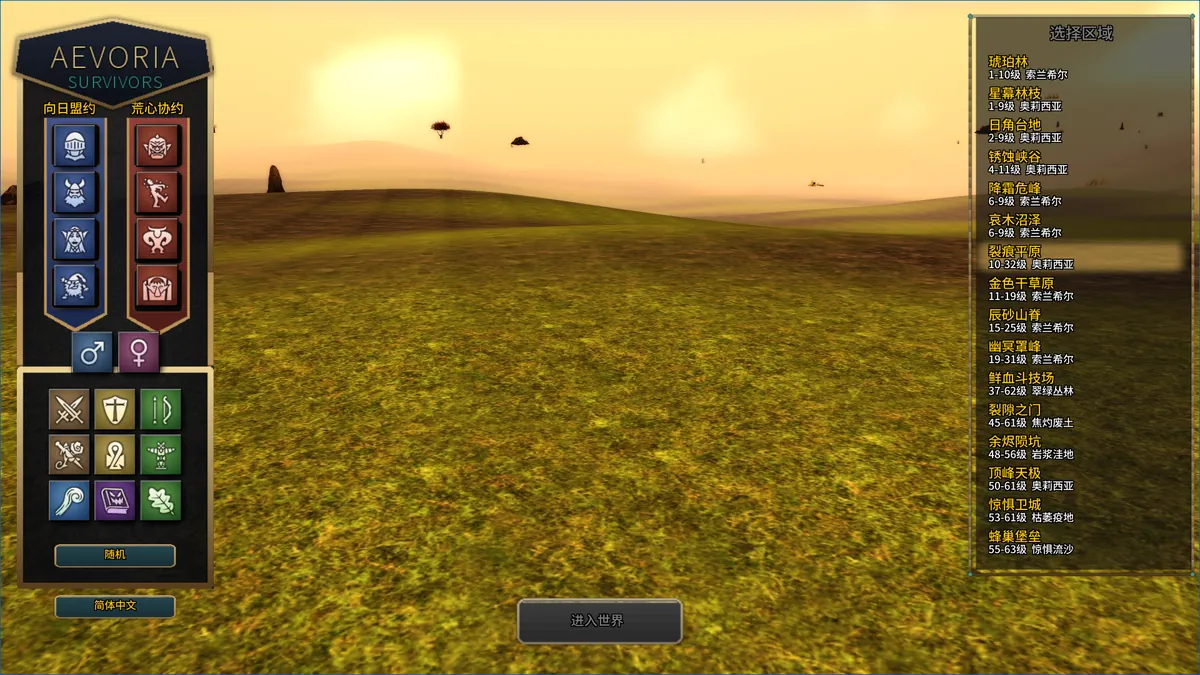
The Druid is one of the nine classes on the setup screen, and class, race and zone are all chosen before you enter the world. Pick the hero first and look at the zones after, because the class is what decides which eight abilities the level-up offers can give you.
Azeroth Survivors Druid build order, step by step
Take Wrath first, Starfire second and Hurricane third, then a damage-over-time pick, and stop at six abilities instead of filling every slot. Eight is the level cap on each ability, so two or three finished abilities carry a run further than six that never leave level one.
- Level Wrath before anything else, because it is the only ability you own at level one and its 1.2 second cooldown is what keeps the opening wave off you.
- Take Starfire as the second ability, because 40 damage on a 4 second cooldown is the biggest single hit in the pool and it lands while your bolt is still travelling.
- Add Hurricane as the third ability, because a ground area with 8 radius that ticks for 7 seconds is the class's only answer to a pack closing from two sides.
- Take Insect Swarm or Entangling Roots as the fourth pick, because both keep damaging several enemies while you walk, at 3 targets for 10 seconds and 4 targets for 5 seconds.
- Take Thorns or Rejuvenation only once your health bar starts deciding runs, because Thorns returns 8 damage to attackers for 15 seconds and Rejuvenation restores 30 health over 10 seconds, so both buy time instead of adding a new damage source.
- Stop at six abilities and push two or three of them to level eight, because eight is the cap and a slot spent on a sixth level-one ability leaves the wave alive.
- Spend the levels after that on passive cards, because all ten passives come from one pool shared by every class and Amplify Magic and Arcane Intellect change what your abilities already do.
Two finished damage abilities carry most of a run, and the third slot is where you fix the kind you are missing: a ground area if you only took strikes, a damage-over-time pick if everything you own is direct damage. An Azeroth Survivors Druid build fills the slots after that for coverage, not for completion.
Which abilities are in the Azeroth Survivors Druid pool?
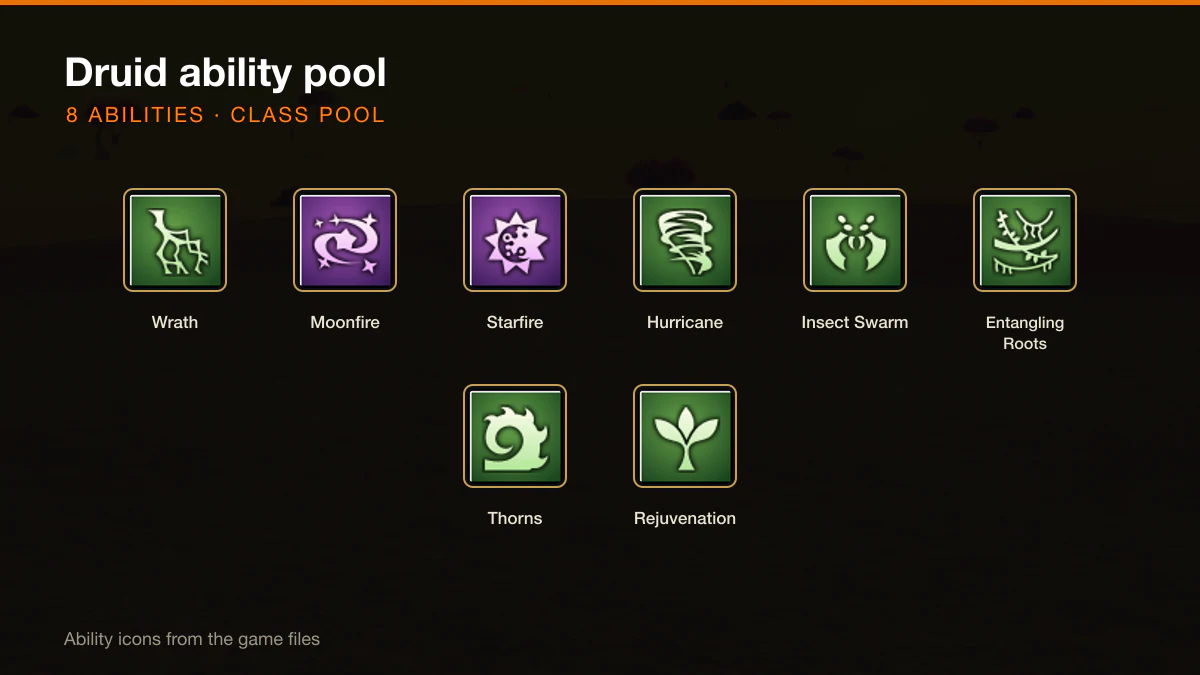
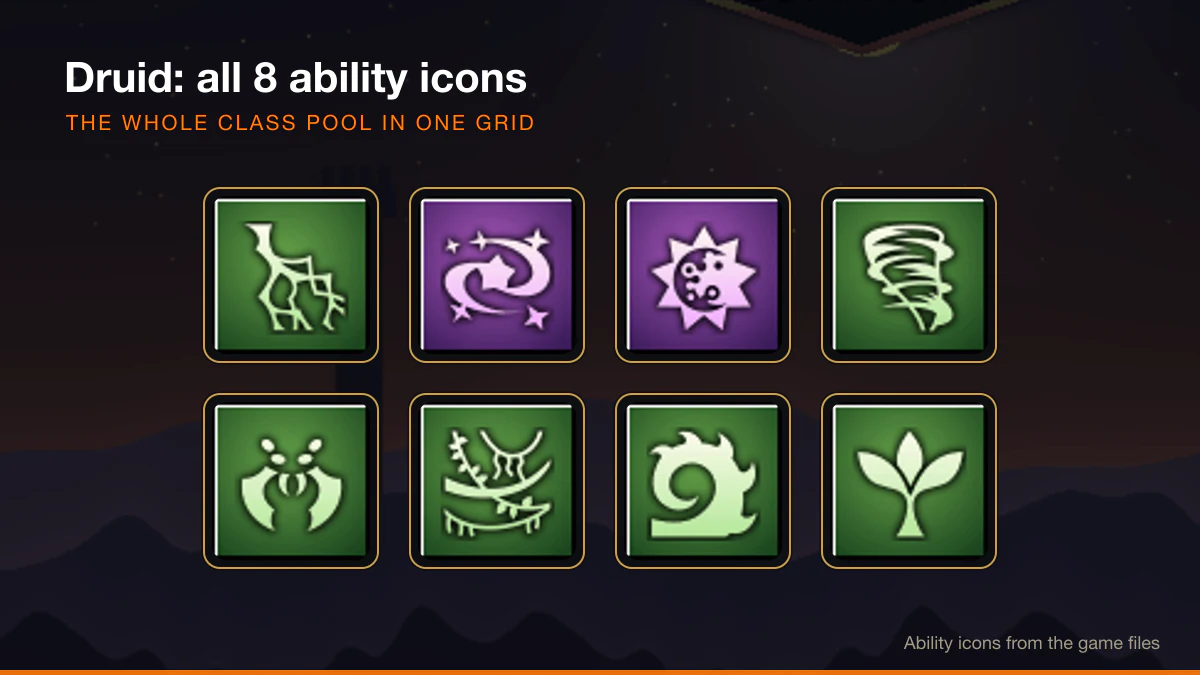
An Azeroth Survivors Druid build draws on eight abilities: one starting pick and seven more from level-up offers. The table copies what the game data stores for each of them, the kind that decides its targeting, base damage, cooldown, the range it reaches, the radius it covers, the enemies a cast touches and how long it lasts.
| Ability | Kind | Damage | Cooldown | Range or radius | Targets | Duration |
|---|---|---|---|---|---|---|
| Wrath | Bolt | 13 | 1.2 s | 24 range | 1 | |
| Moonfire | Strike | 10, plus 3 over time | 2 s | 22 range | 2 | 9 s |
| Starfire | Strike | 40 | 4 s | 24 range | 1 | |
| Hurricane | Ground | 7 | 10 s | 20 range, 8 radius | 1 | 7 s |
| Insect Swarm | Damage over time | 4 over time | 3 s | 20 range | 3 | 10 s |
| Entangling Roots | Damage over time | 2 over time | 6 s | 16 range | 4 | 5 s |
| Thorns | Thorns | 8 returned | 15 s | 20 range | 1 | 15 s |
| Rejuvenation | Heal | 30 healed | 15 s | 20 range | 1 | 10 s |
Read the cooldown column and the pool splits in two. Wrath fires every 1.2 seconds, Moonfire every 2 and Insect Swarm every 3, so those three keep the wave down while you walk. Starfire sits at 4 seconds, Entangling Roots at 6, Hurricane at 10, and Thorns and Rejuvenation at 15, so each of those is spent on a moment rather than continuously.
The damage column does not rank the pool on its own either: Starfire stores 40 every 4 seconds, Rejuvenation stores 30 every 15, and Insect Swarm stores no direct hit at all, only 4 damage over time on 3 enemies. Two abilities also carry an effect the numbers do not show. Hurricane slows whatever stands in it, and the data stores a 0.6 speed multiplier for 1.5 seconds; Entangling Roots holds 4 enemies in place for 4 seconds. A slowed or rooted pack stays inside the next tick, which is why the area picks matter more than their damage suggests.
How do the two Druid routes differ?
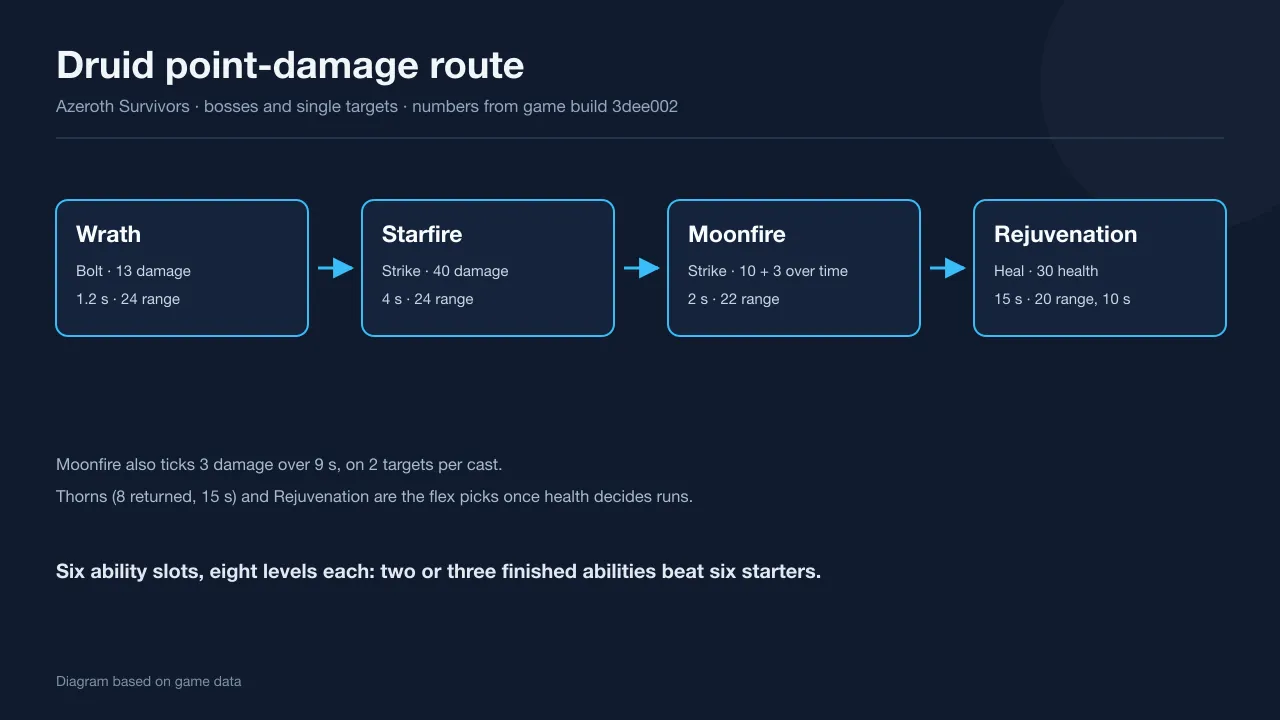
Two routes come out of the same eight abilities. The point-damage route stacks Wrath, Starfire and Moonfire on single targets and adds Rejuvenation when health starts mattering; the area route puts Hurricane, Insect Swarm and Entangling Roots on packs. An Azeroth Survivors Druid build opens both routes on Wrath and stops both at six slots.
The point-damage route: Wrath into Starfire
Wrath carries the opening on its 1.2 second cooldown, Starfire adds 40 damage every 4 seconds, and Moonfire puts 10 damage plus 3 over 9 seconds on 2 targets every 2 seconds. Thorns and Rejuvenation are the flex picks, at 8 returned damage for 15 seconds and 30 health over 10 seconds. This route wants the wave in front of you and a boss you can stand still against.
The area route: Hurricane into Insect Swarm and Entangling Roots
Hurricane drops a 7 damage ground area with 8 radius every 10 seconds and slows what stands in it, Insect Swarm puts 4 damage over time on 3 enemies for 10 seconds every 3 seconds, and Entangling Roots holds 4 enemies for 4 seconds while ticking on them. This route clears a ring from every side, which is what the class needs once enemies arrive from more than one direction.
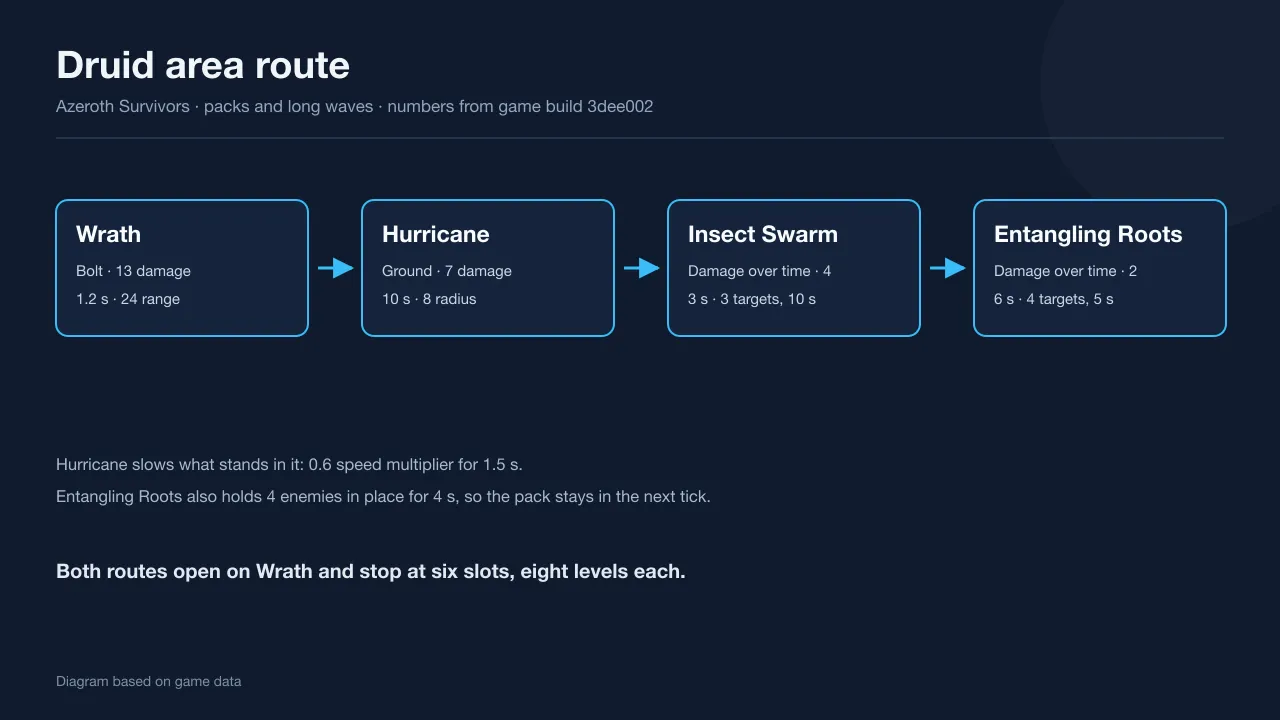
Both routes open on Wrath, because it is the only ability you own when the run starts. Choose between them at the second pick rather than the sixth: with six slots and eight levels each, an Azeroth Survivors Druid build cannot take a slot back.
Which passive cards fit a Druid run?
Passive cards for an Azeroth Survivors Druid build are not Druid-only: the game draws all ten from one pool every class uses, and you hold six at up to five levels each. Amplify Magic raises area size, which the area route leans on, and Arcane Intellect raises attack and cast speed, which every ability benefits from.
| Passive card | Stat it raises | Per level |
|---|---|---|
| Amplify Magic | Area of effect | 0.1 |
| Detect Lesser Invisibility | Pickup radius | 0.4 |
| Power Word: Fortitude | Max health | 0.2 |
| Arcane Intellect | Attack and cast speed | 0.08 |
| Blessing of Kings | Critical strike chance | 0.05 |
| Blessing of Might | Attack power | 0.1 |
| Aspect of the Pack | Movement speed | 0.1 |
| Renew | Health regeneration | 0.5 |
| Mark of the Wild | Armor | 1 |
| Blessing of Wisdom | Experience gain | 0.08 |
The last column is the fraction the data file stores for each level: 0.1 on Amplify Magic, 0.4 on Detect Lesser Invisibility, 1 on Mark of the Wild. Six slots against ten cards means four of them never make the run, so the choice is a cut, not a collection.
For a Druid the two that change the most are Amplify Magic and Arcane Intellect. The first enlarges Hurricane's 8 radius and the reach of both damage-over-time picks; the second shortens every cooldown in a pool whose fast abilities sit at 1.2, 2 and 3 seconds. Power Word: Fortitude and Renew cover the stretch where area damage has not caught up with the wave, and Blessing of Kings adds a critical strike chance to every hit you land.
What mistakes end a Druid run early?
Most Azeroth Survivors Druid build problems end a run on a decision made in the first two minutes rather than on the size of the wave. The six mistakes below cost the most, and every one of them has a number from the ability pool behind it.
- Filling all six ability slots early. An ability you never level stays at level one, and an ability levels to eight, so a sixth slot is usually worth less than a level in Wrath or Starfire.
- Taking Rejuvenation before any area damage. A 30 health heal on a 15 second cooldown buys seconds, and the pack that took your health is still standing on top of you.
- Treating Thorns as a damage ability. It returns 8 damage to enemies that hit you, so it does nothing until they are already touching you.
- Leaving area size alone while Hurricane does the clearing. Amplify Magic is the passive that makes Hurricane's 8 radius and both damage-over-time picks cover more of the screen.
- Standing still because the abilities aim themselves. Auto-cast handles aiming, not positioning, and an early death usually starts with standing inside the pack.
- Skipping the level cap. Each ability has a level cap and a run has a fixed length, so a build that never finishes one ability runs out of damage before the last boss.
One fix covers most of them: decide at the start which two or three abilities reach level eight, then treat every other card as support. A Druid with two finished abilities and four finished passives clears further than one with six half-built abilities and no passive at all.
Azeroth Survivors Druid build FAQ
What ability does the Druid start with in Azeroth Survivors?
Wrath, a Bolt with a 1.2 second cooldown, 24 range and 13 base damage. It is the only ability you own at level 1, so the first level-ups go into it and the other seven only arrive as level-up choices.
What is the best order for an Azeroth Survivors Druid build?
Wrath first, Starfire second, Hurricane third, then Insect Swarm or Entangling Roots, and stop at six abilities. Push two or three of those to level 8 and spend the remaining levels on passive cards.
How many abilities can a Druid hold at once?
Six at a time out of a class pool of eight, and each of those levels up to 8. Passives are tracked separately: six slots, five levels each, drawn from one pool of ten cards that every class uses.
Does the Druid have any melee ability?
No. The pool is one Bolt, two Strikes, one Ground area, two damage-over-time picks, one reflect and one heal, and every kind works at range. A Druid fights by keeping the wave at a distance instead of standing inside it.
Can the Druid heal itself?
Yes, with Rejuvenation: 30 health restored over 10 seconds on a 15 second cooldown. It buys time rather than damage, so it earns a slot once waves wear you down and is safe to skip while Hurricane still clears the screen.
Which Druid ability is best against a pack?
Hurricane, at 7 damage across an 8 radius every 10 seconds, and it slows whatever stands in it. Insect Swarm adds 4 damage over time to 3 enemies and Entangling Roots ticks on 4 enemies while holding them for 4 seconds.
Why does my Druid build stall in the last minutes?
Usually because the cards went into too many different abilities. An Azeroth Survivors Druid build keeps two or three abilities high, and a run has a fixed length while each ability has a level cap, so six level-one abilities have a slot for every situation and damage for none of them.
Which passive cards should an Azeroth Survivors Druid build take?
Amplify Magic for area size and Arcane Intellect for attack and cast speed change what your abilities do, while Power Word: Fortitude, Renew and Mark of the Wild keep you alive. Six of the ten shared cards make the run and four never do.
Data: the game data files that ship with the browser build (game build 3dee002, upstream synced 2026-09-24); last checked 2026-11-02. Independent guide, not affiliated with Blizzard Entertainment or World of Warcraft.
Related builds
More Survivors-like Games



Free in the browser, like the Azeroth Survivors druid build guide above.
Sources
- Azeroth Survivors, the browser game this build is for
- benilla on GitHub: the open-source client this browser port is built on
- How this browser build tracks the upstream client (docs/METHOD.md)
- Spell.dbc reader: how an ability id resolves to its name and magic school
- Spell range table used for the range column
- Spell radius table used for the radius column
- Spell duration reader used for the duration column