Azeroth Survivors Hunter build
Updated 2026-11-02
Version game build 3dee002, upstream synced 2026-09-24
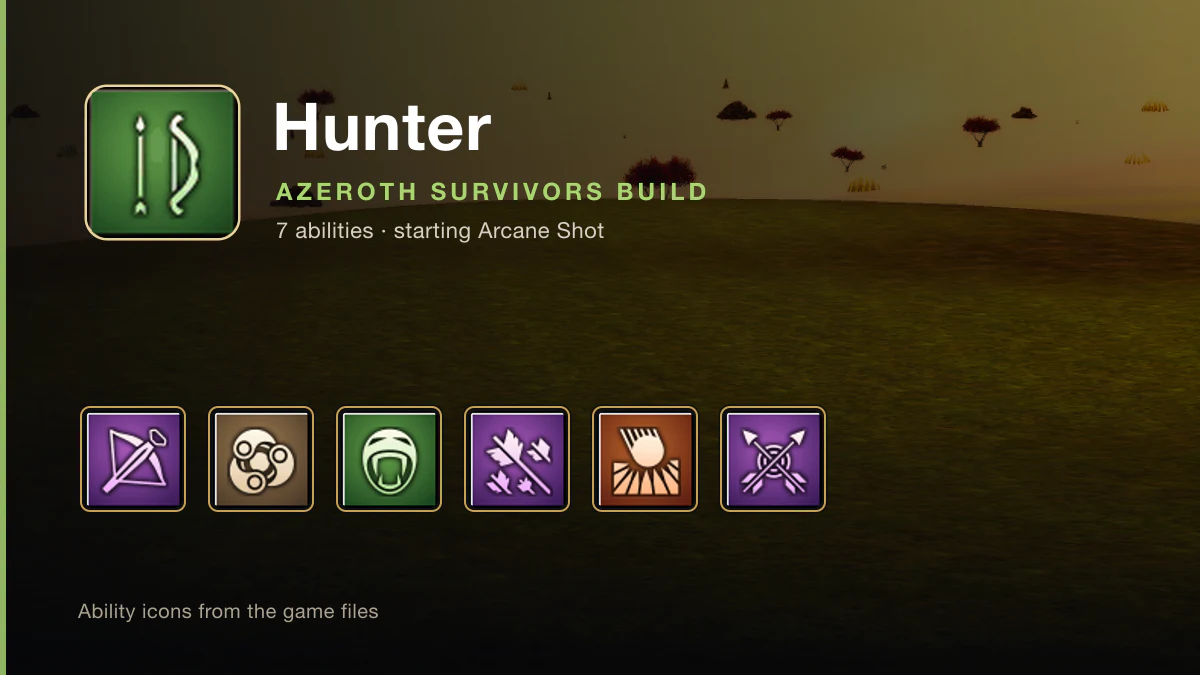
An Azeroth Survivors Hunter build starts on Arcane Shot, 13 damage to one target every second from 28 units away, and the class pool adds six more abilities: Multi Shot, Serpent Sting, Volley, Explosive Trap, Concussive Shot and Aimed Shot. You hold six of the seven at once and level each to eight.
| Hunter at a glance | Value |
|---|---|
| Class | Hunter, an ambusher of the wild with a heavy crossbow |
| Starting ability | Arcane Shot, Bolt, 13 damage on a 1 s cooldown at 28 units |
| Ability pool | 7 class abilities |
| Ability kinds in the pool | 5 Bolt, 2 Ground |
| Abilities held at once | 6 |
| Max ability level | 8 |
| Passives held at once | 6, from the pool every class shares (10 cards) |
| Max passive level | 5 |
| Power type | Mana: the class's power in the data files, and this mode charges no mana, so cooldowns alone gate the shots |
| Run length | A long run, with bosses arriving at intervals |
- Azeroth Survivors classes: which of the nine heroes suits a first run.
- How to play Azeroth Survivors: the level-up offer, the cards and the wave timer.
- Troubleshooting: what to do when the game will not load.
- Azeroth Survivors mobile: running the same build on a phone or tablet.
How does an Azeroth Survivors Hunter build play?
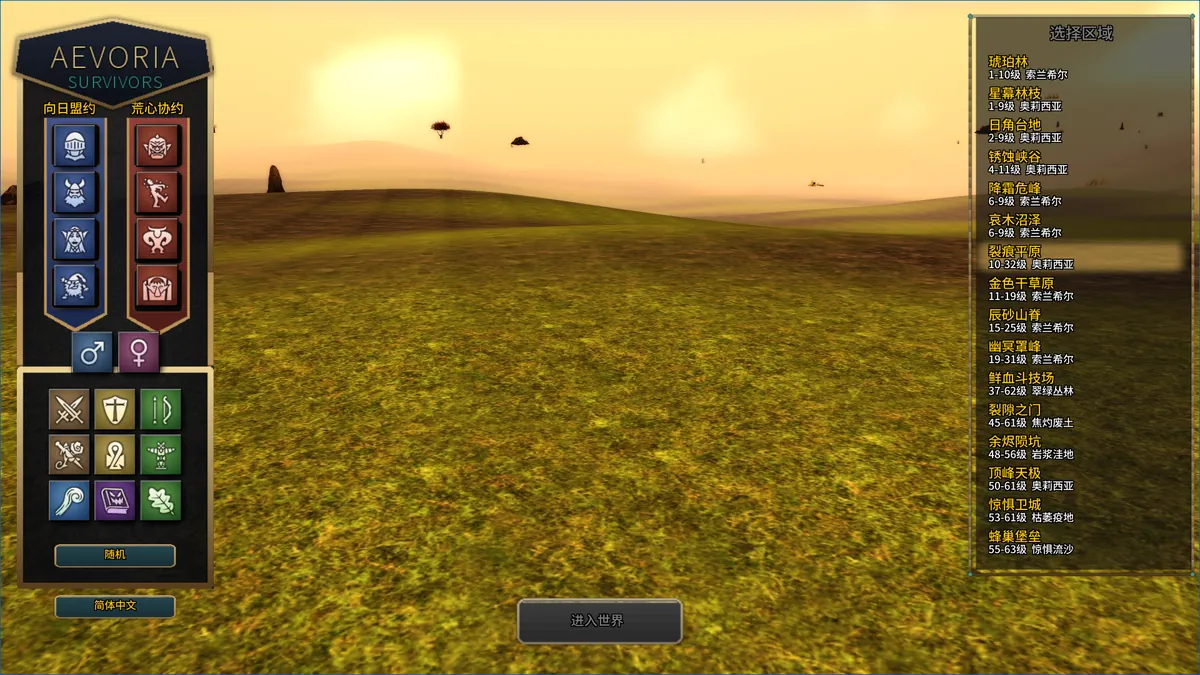
An Azeroth Survivors Hunter build plays at range. Every ability in the pool fires from 14 to 32 units away and none of them is a melee swing, so a run is about keeping a gap open while the shots and the traps do the killing. Nothing is cast by hand: each ability fires on its own cooldown.
Every ability in the pool shoots from a distance
Five of the seven abilities are Bolt abilities that pick a target and fly at it, and the other two are Ground abilities that drop on a spot. Reach runs from 14 units on Explosive Trap to 32 on Aimed Shot, and the two Ground entries are the only ones that ask you to predict where the wave will be instead of where it is. The game's class text calls the Hunter an ambusher of the wild, but there is no stealth and no trap-laying ritual here: the whole class is damage delivered from outside the pack.
What Arcane Shot covers in the opening minute
Arcane Shot hits for 13 damage every 1 second at 28 units, which is the fastest cooldown in the pool, and it aims itself at whatever stands closest. That is enough for the opening waves, where enemies arrive in a thin line. It stops being enough the moment two groups merge, because a single-target shot can only ever eat one enemy per second while the rest keep walking.
What is the best Azeroth Survivors Hunter build order?
Level Arcane Shot first, then Multi Shot, then Serpent Sting, and stop at six abilities. The list below is priority, not a script: the pool holds seven, a run holds six, and each ability levels to eight, so the order you spend cards in decides more than the length of the list.
- Level Arcane Shot first, because it is the only ability you own at level 1 and its 1 second cooldown is what keeps the opening wave off you.
- Take Multi Shot as the second ability, because 10 damage on three targets every 2 seconds is the first thing in the kit that hits a group instead of a single enemy.
- Add Serpent Sting once enemies start surviving the volley, because it leaves 4 damage per second for 9 seconds on two targets and keeps working while you walk away.
- Take Volley when packs arrive from one direction, because 8 damage inside a 7-unit radius for 5 seconds is the widest area the class owns, and it costs a 9 second cooldown.
- Take Explosive Trap when the wave bends around you, because 22 damage plus damage over time inside 5 units punishes anything that walks across the spot.
- Take Aimed Shot before the first boss, because 48 damage every 4 seconds from 32 units is the heaviest hit in the pool and nothing else reaches that far.
- Stop adding abilities at six and push two or three of them to level 8, because the cap applies to each ability separately and two level 6 abilities clear a wave that six level 1 abilities cannot.
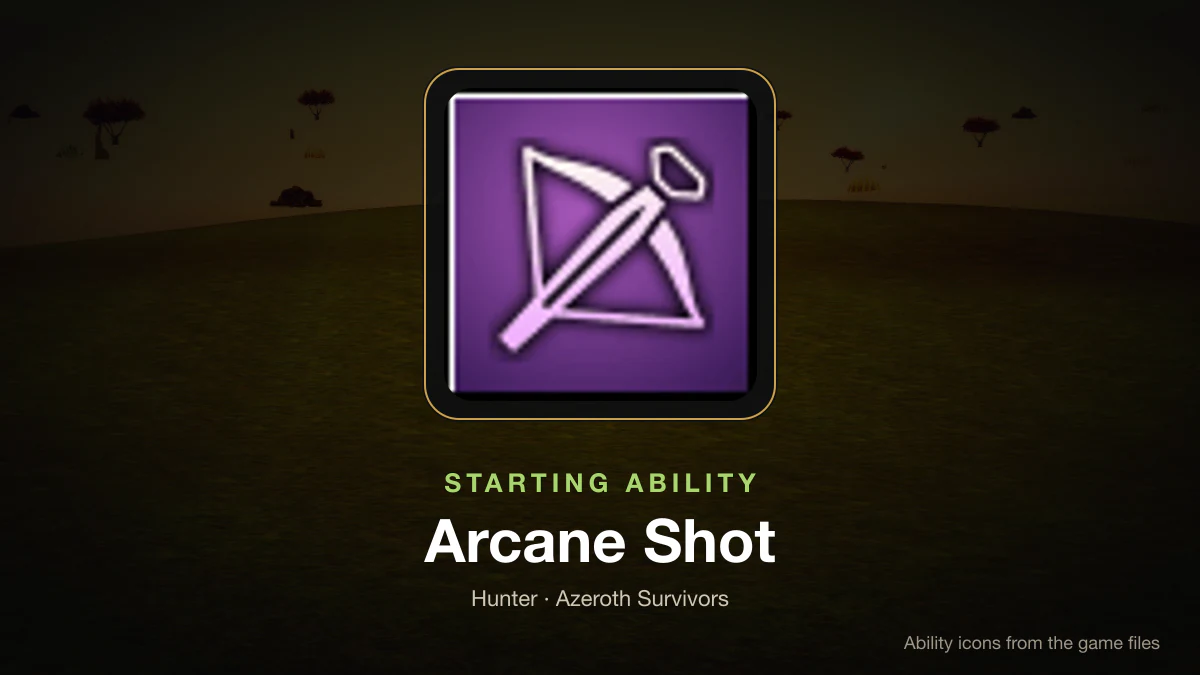
The first three picks decide whether the run reaches the third boss timer. Arcane Shot carries the opening, Multi Shot covers the first group, and Serpent Sting is what keeps damage on a pack while you spend two seconds walking around it. Everything after that is either a second angle of damage or a stat that makes the first two shots bigger.
How much damage does each Hunter ability do?
Every number below is copied from the game's ability table, and the pool is seven entries. The kind decides targeting: a Bolt picks a target and flies at it, a Ground ability lands on a spot you then walk away from. Damage, cooldown, reach and target count are what separate the cheap shots from the finishers.
| Ability | Kind | Damage | Cooldown | Range or radius | Targets |
|---|---|---|---|---|---|
| Arcane Shot | Bolt | 13 | 1 s | 28 units | 1 |
| Multi Shot | Bolt | 10 | 2 s | 26 units | 3 |
| Serpent Sting | Bolt | 2, then 4 per second for 9 s | 2.6 s | 26 units | 2 |
| Volley | Ground | 8 | 9 s | 24 units, 7 radius, 5 s | Everything in the radius |
| Explosive Trap | Ground | 22, then 4 over time | 8 s | 14 units, 5 radius | Everything in the radius |
| Concussive Shot | Bolt | 8 | 3 s | 28 units | 1, with a slow |
| Aimed Shot | Bolt | 48 | 4 s | 32 units | 1 |
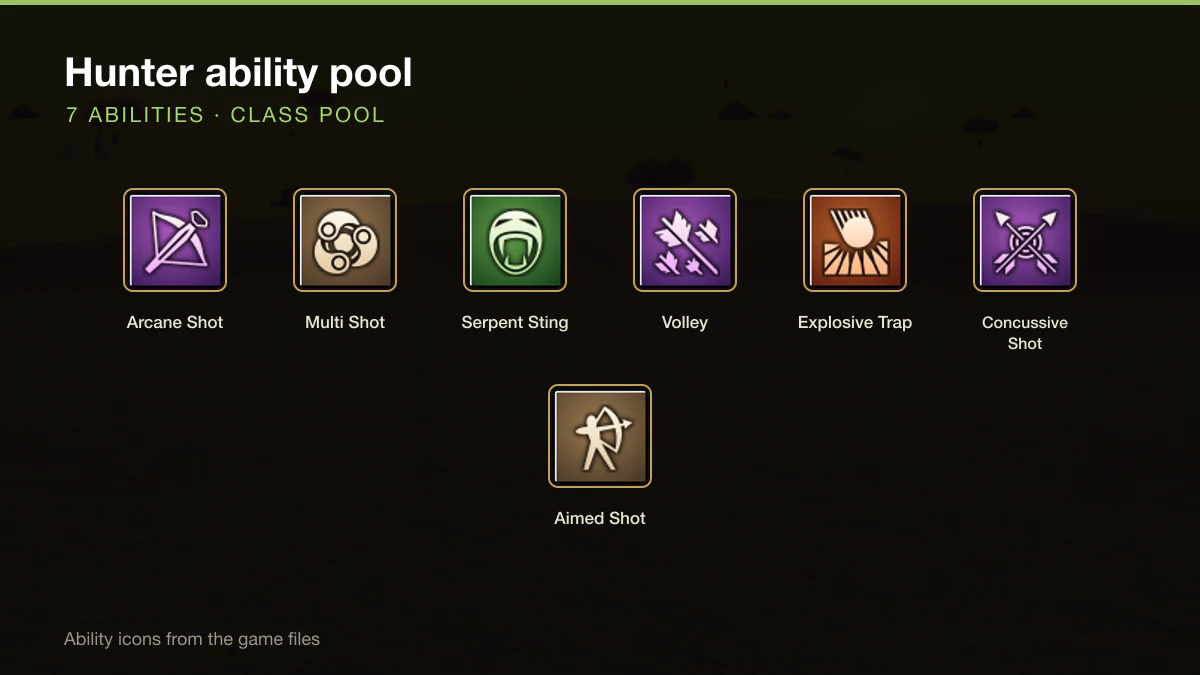
Read the cooldown column and the pool splits in two. Arcane Shot, Multi Shot, Serpent Sting and Concussive Shot all sit at 3 seconds or under and wear a wave down; Aimed Shot, Volley and Explosive Trap sit at 4, 8 and 9 seconds and are spent on a moment. The damage column has the same shape: 48 damage on a 4 second cooldown is not four times better than 13 on 1 second, it is a different tool, aimed at the enemy that has to die now.
Two entries need a second look. Serpent Sting does almost nothing on impact, at 2 damage, and everything after it: 4 damage per second for 9 seconds on two targets. Explosive Trap pays 22 damage up front and then keeps damaging what it catches, which is why it is worth 8 seconds of cooldown while Concussive Shot at 8 damage is the one ability a six-slot run can cut.
Which two Azeroth Survivors Hunter build routes work?
Two routes come out of the same seven abilities in an Azeroth Survivors Hunter build. Route one stacks the two single-target shots and adds Serpent Sting so damage keeps ticking; route two takes both Ground abilities and clears the packs that walk toward you. Both open on Arcane Shot, both hold six slots, and both leave Concussive Shot out.
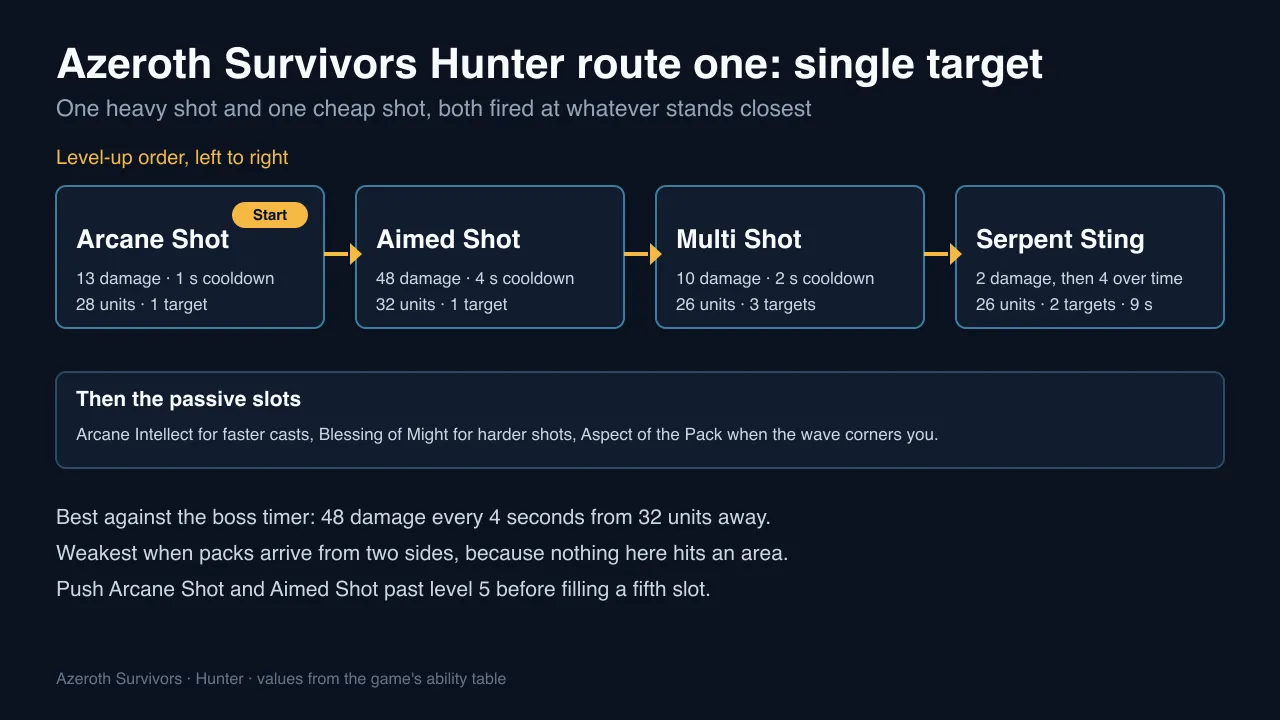
Route one is the boss line: Arcane Shot to level 4 or 5, Aimed Shot next because 48 damage every 4 seconds is the only answer to a boss timer, Multi Shot third for the group that walks in beside the boss, and Serpent Sting last so the damage keeps running while you reposition. It kills a single target quickly and it has nothing to say to a ring of enemies closing from every side, because every ability in the route wants one target in front of it.
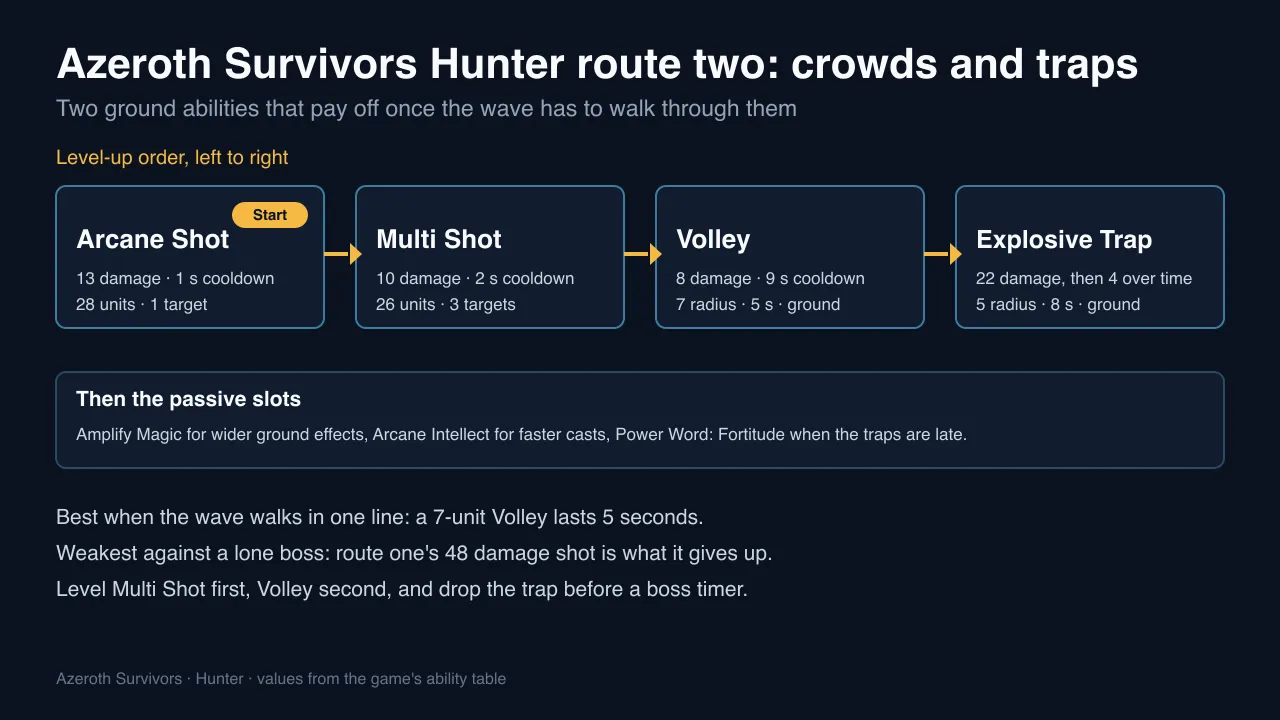
Route two is the crowd line: Multi Shot early so three enemies take damage per volley, Volley next for the 7-unit radius that holds a lane for 5 seconds, Explosive Trap last for anything that walks over the spot. It clears a wave that arrives in a line and it pays for that with a slow boss kill, which is why route one still wins when a boss arrives. Pick the route at the third card, not the sixth: with six slots and eight levels, a slot you spend is a slot you cannot take back.
Which passive cards fit a Hunter run?
An Azeroth Survivors Hunter build takes its passives from outside the class: ten cards are shared by every hero, six can be held at once and each reaches level 5, so a Hunter is offered exactly the list a Warrior gets. The values below are stored per level in the game's data files.
| Passive card | Stat it raises | Per level |
|---|---|---|
| Arcane Intellect | Attack and cast speed | 0.08 |
| Blessing of Might | Attack power | 0.1 |
| Amplify Magic | Area of effect | 0.1 |
| Aspect of the Pack | Movement speed | 0.1 |
| Power Word: Fortitude | Max health | 0.2 |
| Mark of the Wild | Armor | 1 |
| Renew | Health regeneration | 0.5 |
| Blessing of Kings | Critical strike chance | 0.05 |
| Detect Lesser Invisibility | Pickup radius | 0.4 |
| Blessing of Wisdom | Experience gain | 0.08 |
Arcane Intellect and Blessing of Might are the two that change a Hunter run most, because every ability in the pool is a damage source and both cards make those shots land harder or more often. Amplify Magic is the third, and it is the one that decides between the routes: a 7-unit Volley or a 5-unit Explosive Trap grows into a much wider answer to a crowd, while a single-target route gets almost nothing from it.
When to take a passive instead of an ability
Take a passive while your damage already handles the current wave and the problem is eating you, movement or cooldowns, and take a fresh ability while the wave still outlives your shots. A new ability hands you a second damage source; a passive can only scale what you already own, so it pays off later than it looks and earlier than a seventh ability you cannot hold.
Why does an Azeroth Survivors Hunter build die early?
Most Azeroth Survivors Hunter build runs end on a decision made in the first two minutes, not on the size of the wave. The kit is ranged and thin: five of the seven abilities hit one target or three, only two hit an area, and none heals, stuns or dashes. These mistakes are what turn that thin kit into a death.
- Standing still to let the shots land. Every ability aims itself, so standing still buys nothing and gives the wave the seconds it needs to close 28 units.
- Buying a seventh ability. Six is the cap, so that card does nothing for the rest of the run.
- Levelling all six abilities evenly. Eight is the cap per ability, and a spread build reaches the second boss with six abilities at level four.
- Taking both Ground abilities on a single-target run. Volley on a 9 second cooldown and a trap on 8 seconds are dead cards against one boss.
- Dropping Volley or Explosive Trap where nothing will walk. Both land on a spot and last for a duration, so they pay off only when the crowd has to cross them.
- Skipping movement passives because the class is ranged. Nothing in the pool moves you, so Aspect of the Pack is the only escape tool the Hunter gets.
One fix covers most of those: decide at the start which two or three abilities reach level 8, then treat every other card as support. An Azeroth Survivors Hunter build with three finished abilities and three finished passives clears further than one with six half-built abilities and no passive at all.
Azeroth Survivors Hunter build FAQ
What ability does the Hunter start with in Azeroth Survivors?
Arcane Shot, a Bolt that does 13 damage on a 1 second cooldown at 28 units. It is the only attack you own at level 1, so the first level-ups go into it, and it fires by itself at whatever stands closest.
What is the best Azeroth Survivors Hunter build for a first run?
Level Arcane Shot, add Multi Shot for groups, then Serpent Sting for damage that keeps ticking, and take Aimed Shot before the first boss timer. Stop at six abilities, push two or three of them to level 8, and leave Concussive Shot out unless its slow is what keeps you alive.
How many abilities can a Hunter hold at once?
Six at a time out of a class pool of seven, and each of those levels up to eight times. Six slots also means one ability from the pool never makes the run, which is why every Hunter build in this mode is a decision about what to cut rather than a list to complete.
Which Azeroth Survivors Hunter build route should I pick?
Take the single-target route when your runs end on a boss, and the crowd route when they end to a wave arriving in a line. The first stacks Aimed Shot with Arcane Shot and Serpent Sting, the second takes Multi Shot, Volley and Explosive Trap, and both fit in the same six slots.
Is the Hunter a good class for a first run in Azeroth Survivors?
It is one of the easier ones to start with, because every ability works from 14 units or further and you never have to enter the pack. It is also thin: seven abilities, two of them Ground, no heal and no dash, so a first run rewards clean movement more than a big damage number.
Which passive cards should a Hunter take?
Arcane Intellect for attack and cast speed, Blessing of Might for attack power, then Amplify Magic if you took Volley or Explosive Trap. Passives come from one pool of ten cards shared by every class, six can be held at once and each reaches level 5.
Why does my Hunter run stop killing things at the end?
Usually because the cards went into too many different abilities. An Azeroth Survivors Hunter build does not reward width: two or three abilities at level 6 or 7 out-damage six abilities at level 2, and a run is long with bosses arriving throughout.
Data: open-source engine data (game build 3dee002, upstream synced 2026-09-24); last checked 2026-11-02. Independent guide, not affiliated with Blizzard Entertainment or World of Warcraft.
Related builds
More Survivors-like Games


Free in the browser, like the Azeroth Survivors hunter build guide above.
Sources
- Azeroth Survivors, the browser game this build is for
- benilla, the open-source Warcraft 1.12 engine the game runs on
- benilla docs: METHOD.md, how the project verifies game data
- benilla README: engine scope and code layout
- Warcraft Wiki: Arcane Shot, the name the starting ability uses
- Warcraft Wiki: Multi-Shot
- Warcraft Wiki: Serpent Sting
- Warcraft Wiki: Aimed Shot