Azeroth Survivors Talents: Talent Trees and Builds

Updated 2026-11-06
Version game build 077e7fb, data exported 2026-11-04
Azeroth Survivors talents shape a run through rank bonuses, milestones, and capstones. Each class has three trees, and each tree offers its own mix of effects: some add attacks or companions, some spread damage across nearby enemies, and others improve survival. Compare the tree themes and signature talents here, then choose around the play style you want.
How do Azeroth Survivors talents work?
Each talent belongs to a class tree and has a type: rank talent, milestone, or capstone. Rank talents provide per-rank effects, while milestones and capstones add signature changes that can alter how familiar spells behave. Across the game, there are 345 talents: 263 rank talents, 54 milestones, and 28 capstones. The totals give a useful sense of how much of each tree is made up of each kind of choice.
| Talent type | Count | What it is |
|---|---|---|
| Rank | 263 | Small bonus you put points into |
| Milestone | 54 | A tree's mid-point effect |
| Capstone | 28 | The tree's final talent |
When comparing trees, focus on how their effects handle enemies. Extra strikes, cleave, damage over time, and companions change how attacks reach targets. Shields, healing, damage reduction, and effects that prevent a killing blow support survival. Rank talent wording is available, but per-rank values are not; compare specific effects through the milestone and capstone descriptions.
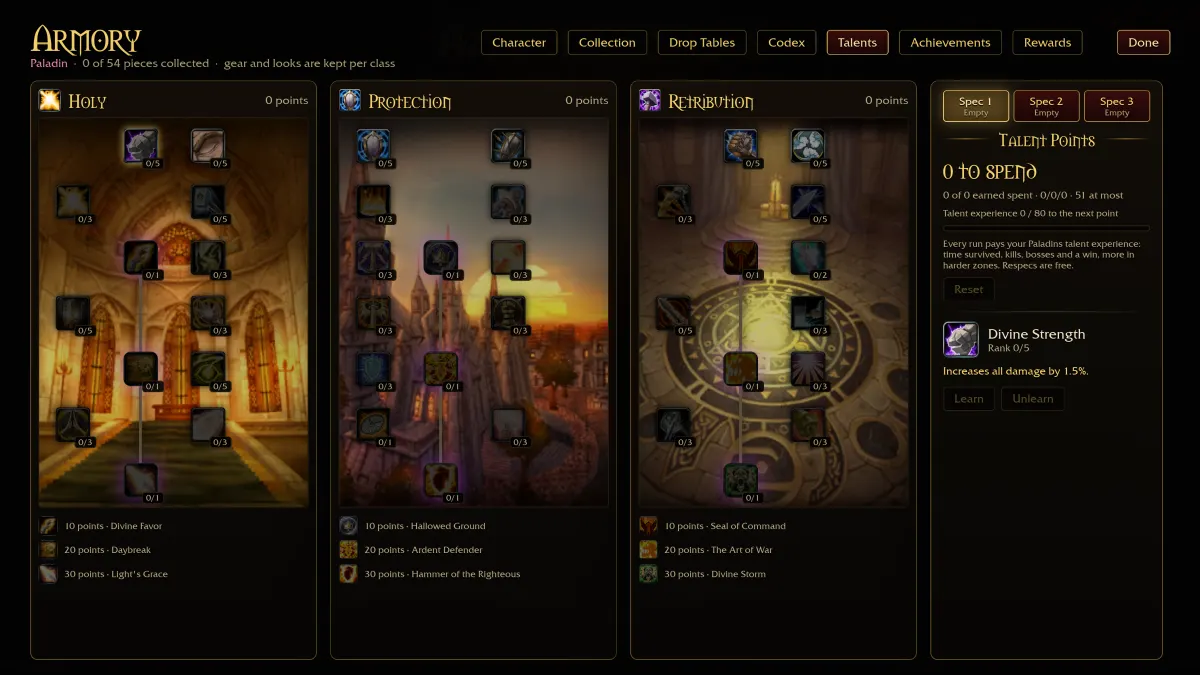
Azeroth Survivors talents are easiest to compare by their effect, rather than by the tree name alone. If you want help planning around a class, browse the class builds or open a guide such as the Warrior build.
How many talent trees does each class have?
Each class has three trees: nine classes and 27 trees overall. Trees range from 10 to 14 talents. Most have 13; Warrior and Paladin Protection have 14, while Paladin Retribution, Hunter Survival, Rogue Combat, and Shaman Enhancement have fewer. The table lists every tree and its count.
| Class | Tree | Talents | Capstone |
|---|---|---|---|
| Warrior | Arms | 13 | Mortal Wounds |
| Warrior | Fury | 13 | Bladestorm |
| Warrior | Protection | 14 | Titan |
| Paladin | Holy | 13 | Light's Grace |
| Paladin | Protection | 14 | Hammer of the Righteous |
| Paladin | Retribution | 12 | Divine Storm |
| Hunter | Beast Mastery | 13 | Bestial Wrath |
| Hunter | Marksmanship | 13 | Kill Shot |
| Hunter | Survival | 12 | Wyvern Sting |
| Rogue | Assassination | 13 | Toxic Bloom |
| Rogue | Combat | 10 | Killing Spree |
| Rogue | Subtlety | 13 | Shadow Dance |
| Priest | Discipline | 13 | Penance |
| Priest | Holy | 13 | Chastise |
| Priest | Shadow | 13 | Shadowform |
| Shaman | Elemental | 13 | Elemental Mastery |
| Shaman | Enhancement | 10 | Feral Spirit |
| Shaman | Restoration | 13 | Totemic Wrath |
| Mage | Arcane | 13 | Arcane Power |
| Mage | Fire | 13 | Pyroclasm |
| Mage | Frost | 13 | Summon Water Elemental |
| Warlock | Affliction | 13 | Seed of Corruption |
| Warlock | Demonology | 13 | Summon Felguard |
| Warlock | Destruction | 13 | Rain of Chaos |
| Druid | Balance | 13 | Force of Nature |
| Druid | Feral Combat | 13 | Dire Bear Form, Cat Form |
| Druid | Restoration | 13 | Tree of Life |
The count tells you how many talents belong to a tree, but not how its effects play. For that, check the milestones and capstone listed alongside the tree. Their names and effects help show whether a path leans toward attacks that spread, recurring spells, companions, or staying power. For a particular class, the class guide index can help you find its related build page.

What are milestone and capstone talents?
Milestones add notable effects within a tree; capstones are its signature closing talents. Many milestones change existing spells: attacks hit nearby enemies, critical strikes trigger spells, or spells apply damage over time. Others grant an ability at the start of every run, add companions, or protect you. Capstones often combine changes into a defining tree effect.
Warrior Arms shows how the pieces can build on one another. Deep Wounds makes critical strikes cause bleeding, and Sweeping Strikes lets Cleave, Mortal Strike, and Execute hit nearby enemies too. Its capstone, Mortal Wounds, starts every run with Mortal Strike and lets a killing blow from Mortal Strike or Execute ready it again at once, at most once a second. Together, those effects reward a path built around those attacks.
Other trees make their identity clear through a different combination. Paladin Holy has Divine Favor, which starts every run with Holy Shock and lets its bolts leap to more enemies, while Light's Grace sends out a Holy Wrath on its own. Hunter Beast Mastery adds a wolf at its Tame Beast milestone, then adds a raptor with Bestial Wrath. These signatures are useful when deciding whether you want spells to spread or companions to fight beside you.

The best milestone or capstone depends on the effect you want to build around. A starting ability changes your opening options, while a repeating free cast or a companion adds pressure throughout a run. For more examples tied to a specific class, compare the Paladin builds with the Hunter builds.
Which Azeroth Survivors talents change a run the most?
The biggest changes come from talents that add a recurring attack, make attacks spread, or change your starting ability. Mage Arcane's capstone, Arcane Power, starts every run with Arcane Missiles instead of Fireball and makes spells strike twice more often; an echo can roll again, up to three more times in a row. Druid Balance's Starfall adds a free Starfire every four seconds, and its Force of Nature capstone brings two treants and starts every run with Moonfire.
For attacks that spread, several trees turn a hit on one target into pressure on a group. Warrior Arms has Sweeping Strikes, Rogue Combat has Blade Flurry, and Warlock Destruction has Shadow Cleave. Their effects let named attacks reach nearby enemies. Mage Frost's Splitting Ice spreads Frostbolt damage around its target, while Paladin Retribution's Divine Storm makes Exorcism burst around its target.
Companions create another strong change in how combat looks. Hunter Beast Mastery pairs you with a wolf and then a raptor; Shaman Enhancement brings two spirit wolves; Warlock Demonology adds an Imp and later a Felguard. Some companion effects also extend their attacks to nearby enemies. If you prefer a defensive direction, Warrior Protection's Titan raises the damage reduction ceiling and adds health-based damage to spells, while Priest Discipline can turn a broken shield into a burst of holy light.

For a first comparison, pick a single theme: recurring attacks, attacks that spread, companions, or survival. Then read the milestone and capstone effects in trees that share it. This makes Azeroth Survivors talents easier to judge than choosing by class fantasy alone. Use the same approach when comparing Azeroth Survivors talents across classes.
Which talent tree should a new player pick first?
Start with the tree whose described effects sound easiest for you to follow. A tree that grants a familiar ability at the beginning of every run makes that starting change explicit. A tree with a companion gives you another presence on the battlefield, while a tree built around repeated casts or spreading damage makes its offensive theme clear. There is no single first choice established for every player in the tree descriptions.
If you want a straightforward theme, compare Hunter Beast Mastery for its wolf and raptor, Mage Frost for its Water Elemental and recurring Frost Nova, or Druid Balance for its treants and free Starfire. If staying alive is your priority, look at Warrior Protection, Paladin Protection, Priest Discipline, or Druid Restoration. Their listed effects include shields, damage reduction, healing, or protection from a killing blow.
Before settling on a tree, read its milestones and capstone together. Check whether the capstone starts you with a different spell, adds a recurring effect, or changes how your attacks reach enemies. Then use the class page that fits your choice, such as the Mage build or Druid build, to explore its options. The right starting tree is the one whose effects make sense to you and support the kind of run you want.

Azeroth Survivors Talents FAQ
How many Azeroth Survivors talents are there?
There are 345 talents across 27 trees for nine classes. That total includes 263 rank talents, 54 milestones, and 28 capstones.
Do rank talents show their exact values?
Their wording is known, but per-rank values are filled in by the game's logic and are not exported. Compare the described effects without assuming a value that is not shown.
Can I choose more than one capstone for a tree?
The listed tree information identifies its capstone and describes its effect. It does not establish how many capstones a player can choose, so use the in-game choices to see what is available.
Which Azeroth Survivors talents add companions?
Hunter Beast Mastery adds a wolf and later a raptor, while Shaman Enhancement adds spirit wolves. Warlock Demonology adds an Imp and then a Felguard.
Which talent trees help with survival?
Warrior Protection, Paladin Protection, Priest Discipline, and Druid Restoration list defensive effects such as shields, damage reduction, healing, or protection from a killing blow. Read each milestone and capstone to see which effects suit your approach.
Data: the game's own English language table inside the browser build (wenilla_bg.wasm). Per-rank talent values live in game logic and are not exported, so they are not listed here.
Sources
- Azeroth Survivors, playable in the browser
- wenilla engine, the open-source client this build runs on
- wenilla engine: browser client source (web/)
- benilla, the open-source engine behind the browser build
- benilla README: what the open-source client is and how it is built
- wenilla engine: class table reader (chr_classes.rs)
- benilla app source tree (client and game modes)