Azeroth Survivors items: the Codex, slots and Armory drops
Updated 2026-11-15
Version 0.143.3, checked 2026-11-15
Azeroth Survivors items split into two pools: in-run jewelry (rings, trinkets and amulets) recorded in the Codex, and permanent Armory gear earned between runs. This page covers all 142 Codex entries, the slot rules, and the boss drop tables behind Armory loot.
Every Azeroth Survivors items question below is answered with numbers from the current build. You get the 142 Codex entries, the slot rules, the Elwynn Forest drop table and what survives a run. Each class draws from its own pool, so the classes pages matter as much as the list itself.
Azeroth Survivors items: the two systems
Azeroth Survivors items come from two separate pools. During a run you are offered jewelry — rings, trinkets and amulets — and the Codex logs each offer. Permanent armor and weapons come from boss kills and land in the account bag; they equip after the run, never during it.
That split decides everything else on this page. A run gives you six spell slots, two ring slots, two trinket slots and one amulet slot, so the jewelry you accept competes for a very small number of places. Armory gear does not compete with any of that; it changes the hero you start the next run with. The how to play page covers run structure in more detail.
The 142-entry Codex: rings, trinkets and amulets
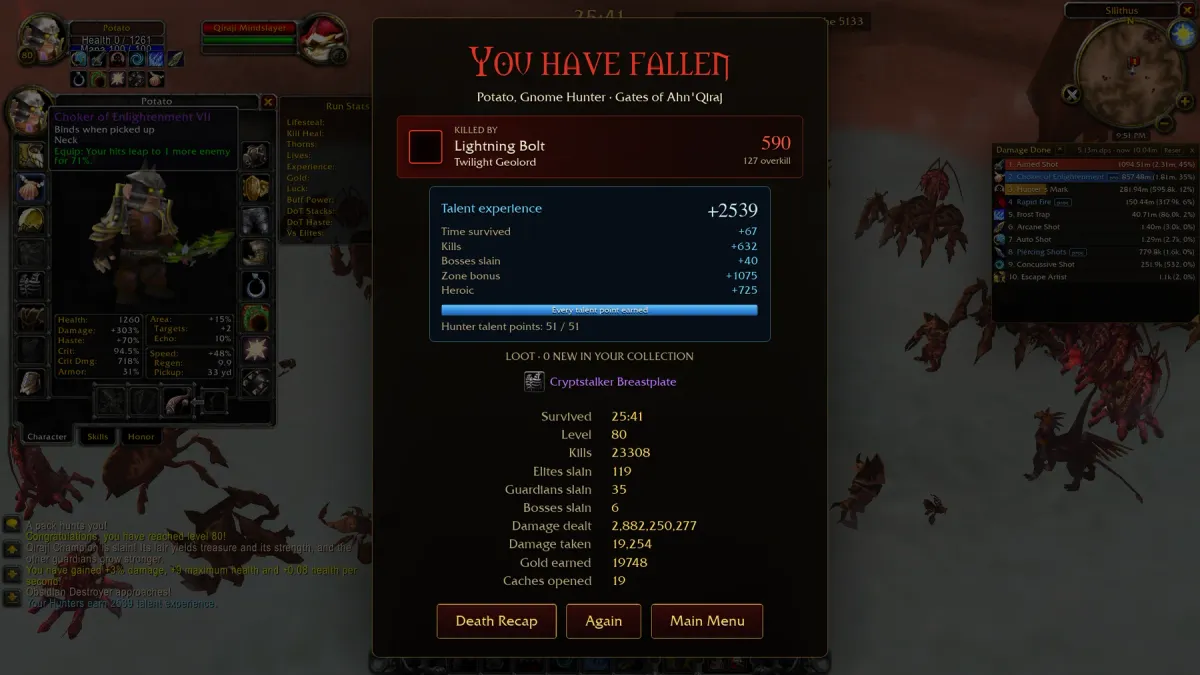
The Azeroth Survivors item codex is the catalogue of everything a run can offer you. In the v0.120.x listing dated 2026-10-26 it holds 142 entries: 9 rings, 14 trinkets, 16 general amulets and 103 class spell amulets.
| Codex family | Entries |
|---|---|
| Rings | 9 |
| Trinkets | 14 |
| General amulets | 16 |
| Class spell amulets | 103 |
| Total | 142 |
The 103 Legendary spell amulets are allocated per class spell, one each. Six classes get 11, Warlock and Druid get 12, and Mage gets 13 — the largest single allocation in the game. That is why a Mage codex reads deeper than any other class, even though the ring and trinket rows are identical for everyone.
Reading by family is faster than scrolling the whole list. The 9 rings and 14 trinkets are rows every class shares, so the useful comparison is between your own spell amulets and the 16 general amulets, not between your class and somebody else's.
Slots and stacking ranks explained
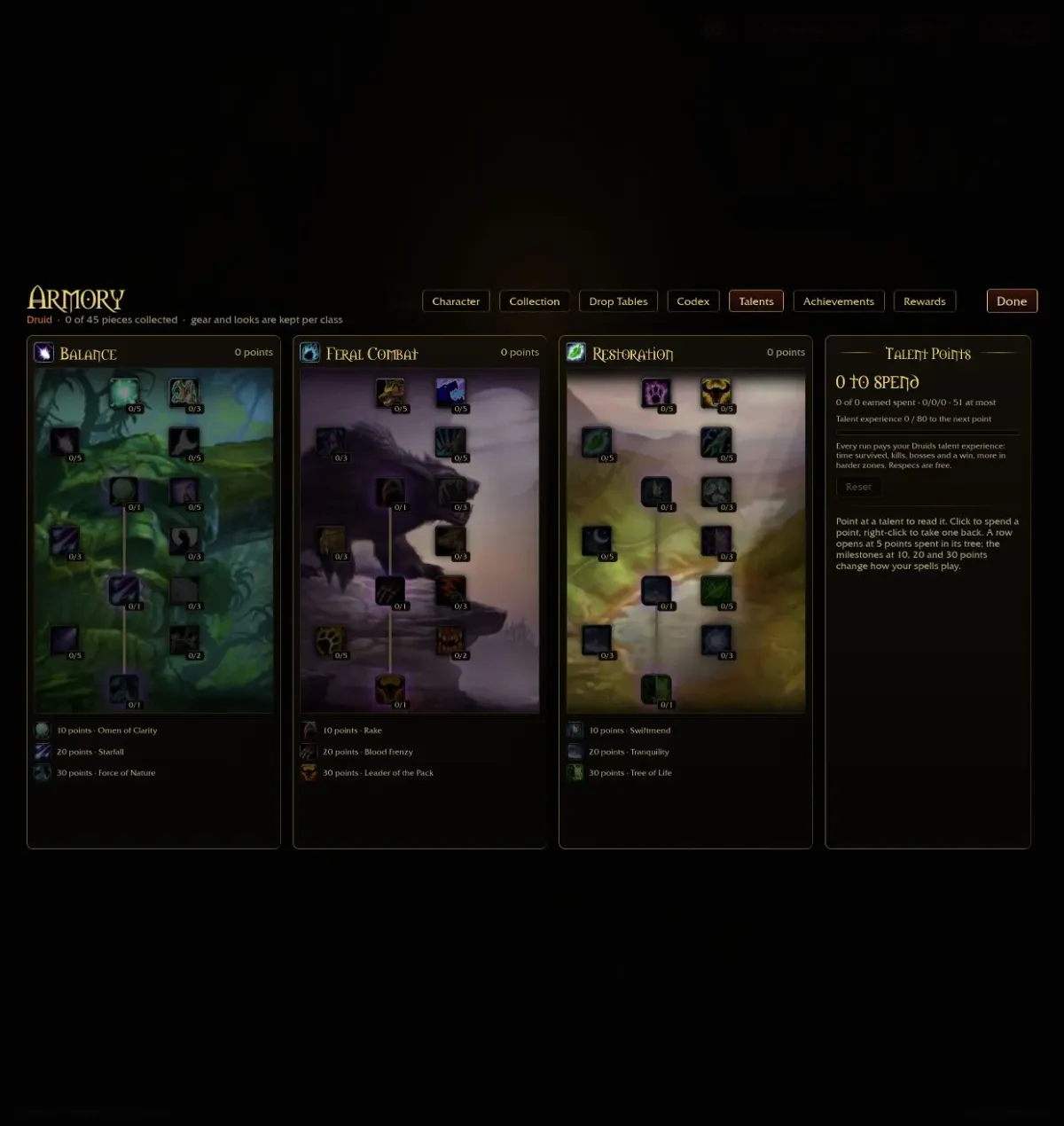
A run hands you six spell slots, two ring slots, two trinket slots and one amulet slot. Rings and trinkets each occupy their own slot type and stack up to five ranks. Taking the same item again strengthens it instead of consuming another slot, so a rank-5 ring still costs one ring slot.
| Slot | Per run |
|---|---|
| Spell | 6 |
| Ring | 2 |
| Trinket | 2 |
| Amulet | 1 |
The official slot table outside the run lists 12 slot types: nine armor slots — Head, Shoulder, Chest, Waist, Legs, Feet, Wrist, Hands, Back — plus three weapon slot types. Those are Armory slots, not run slots, and they never appear in the Codex.
Rings, trinkets and amulets do not stay after a run; only the Armory armor and weapon pieces persist, which is why stacking ranks during a run is a temporary decision rather than a permanent investment.
Item effects by rarity (Blooddrinker's Band and friends)
Most Codex entries are small, readable effects rather than stat sticks. Blooddrinker's Band is the cleanest example: at Common quality it heals you for 1.5% of all damage dealt the moment you first take it. Pick it up again and the item strengthens through its ranks instead of eating your second ring slot.
Beyond Common, the pages checked here do not publish a full rarity ladder for jewelry, so treat any tier order you see elsewhere as unconfirmed. Common is what you can verify: it is the starting quality for Blooddrinker's Band and the tier name attached to Elwynn Forest drops.
Horn of the Warchief is a different case. The item data checked here does not list which buffs it strengthens, so that detail lives on the wiki items page rather than in the drop or Codex tables. Treat any specific buff list as unconfirmed until it is written down there.
Armory gear: bosses, zones and drop chances
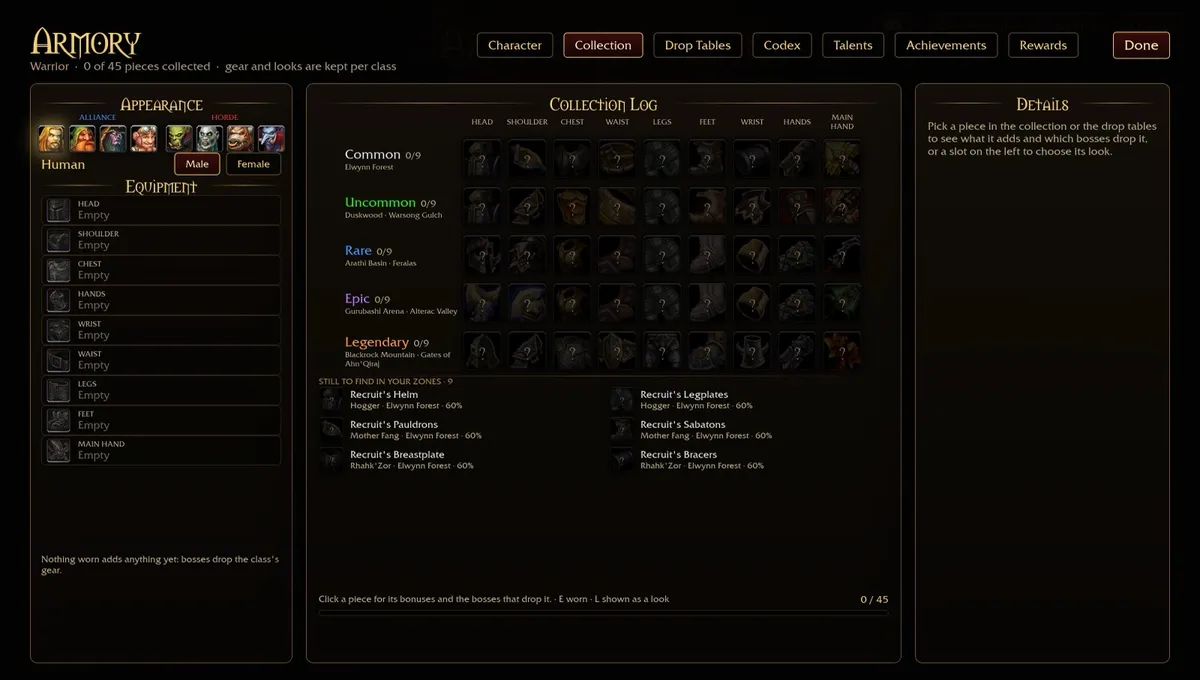
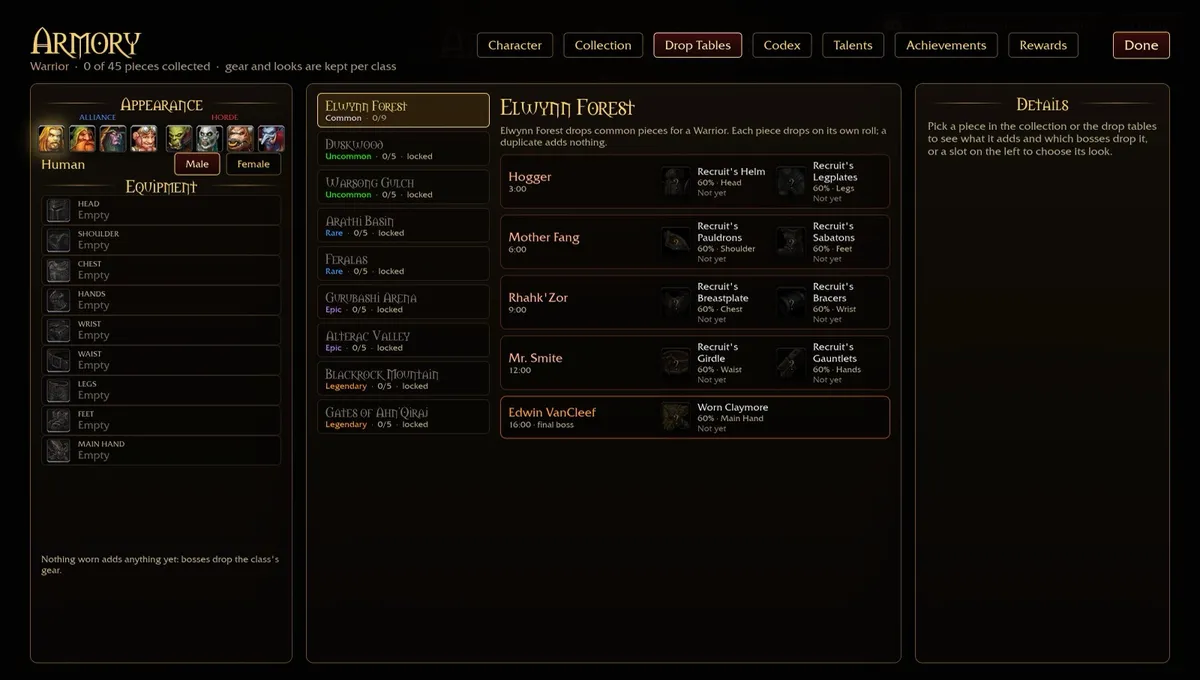
Boss drop tables exist for all 13 zones, covering 65 bosses, and each table shows the eligible items for the selected class. Elwynn Forest is the Common-tier zone, and every piece it lists displays a 60% base chance.
The original V0.90.0 Elwynn tables list nine Common equipment pieces each for Paladin, Hunter and Druid: 27 entries across five bosses. Each inspected entry shows 60%, and every piece rolls separately, so one kill can hand over more than one item.
| Elwynn Forest detail | Value |
|---|---|
| Documented classes | Paladin, Hunter, Druid |
| Verified Common entries | 27 |
| Bosses covered | 5 |
| Displayed chance per piece | 60% |
| Final boss appearance | 16:00 |
Two cautions. The 60% is the drop menu's displayed per-piece chance, not an empirical rate measured from kills. And the times in those tables are boss appearance times, with 16:00 marking the region's final boss.
Class matters here. The Elwynn tables list eligible items per class, and the only three documented so far are Paladin, Hunter and Druid across 27 entries. Other classes have their own filtered views, but those rows were not part of the verified sample.
How to farm Azeroth Survivors items efficiently
Most Azeroth Survivors items you want are gated by two things: which boss you can reach and how many separate rolls you get. Because each piece rolls independently, pushing to the 16:00 boss pays better than camping one early spawn — it is a whole extra set of rolls rather than a repeat of the same one.
Free rerolls come first. After that, paid rerolls cost 100 gold, then 300 and 900. Separately, the level-up offer has no reroll at all, so plan your skills around what you are actually shown rather than what you hoped for.
For route planning, the bosses and zones pages list what spawns where; neither changes the per-piece roll rules above, but both shorten the walk between attempts.
A simple habit before each run: pick the two ring lines and the one trinket line you are chasing, then accept the first offer that matches. Chasing a second option late usually costs the slot a rank-5 copy would have filled.
Codex vs Collection: what actually persists
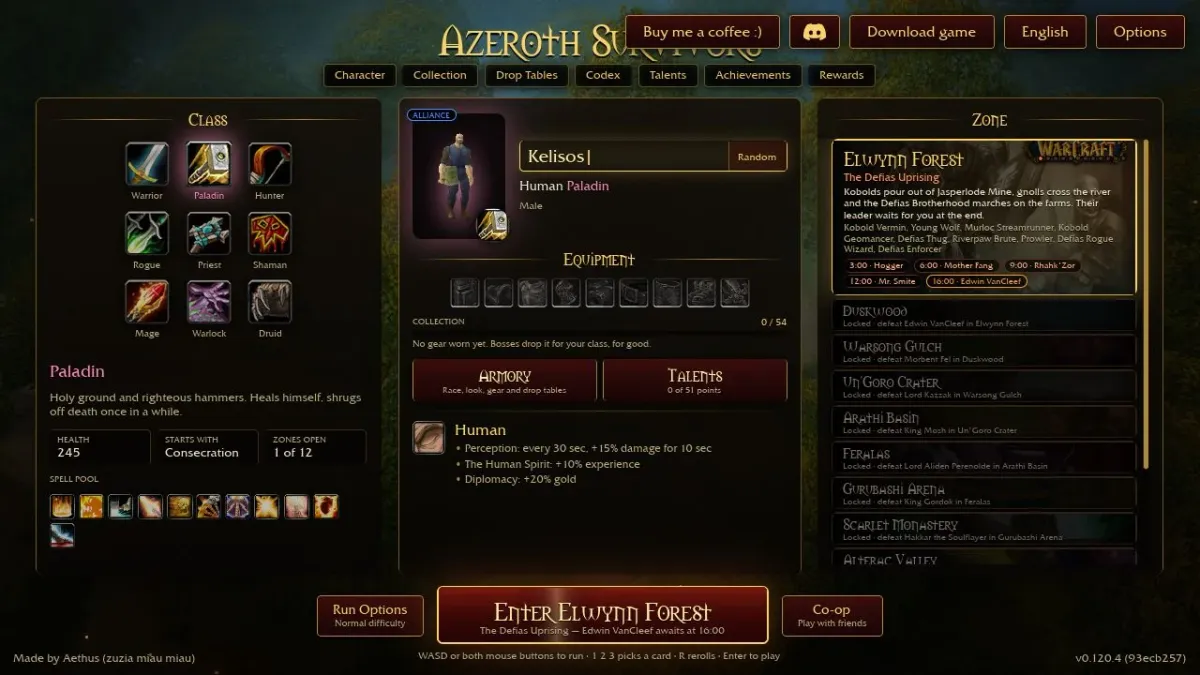
The Codex records offers, not permanent ownership. Seeing a ring in an offer screen fills a Codex row; it does not put the ring into a collection you keep. The only permanent pool is Armory gear, which drops into the account bag and is equipped between runs.
One number is worth flagging. The Bauble reward is described as requiring all 141 items listed in the Codex, while the Codex total in the v0.120.x listing is 142. That one-entry gap is not resolved by the data checked here, so re-check in game before planning a Bauble run around either figure.
So finding an item in the Codex never equips it. It marks that a hero was offered it once, and that mark is what completion rewards look at — not what your next hero starts with.
For the mechanics behind individual entries, start with item sets and the wiki items page, then compare across classes on the tier list.
Azeroth Survivors items: frequently asked questions
Where do Azeroth Survivors items come from?
Jewelry comes from offers during a run and is logged in the Codex; permanent armor and weapons come from boss drop tables across 13 zones and land in the account bag.
Does finding an item in the Codex equip it?
No. The Codex records offers, not ownership, so nothing is equipped from it. Run jewelry exists only inside that run, and Armory gear is equipped after the run ends.
Can I choose a specific item from the next cache?
No. Each piece rolls separately, and the 60% shown in the Elwynn tables is the displayed per-piece chance, not a pick from a list.
Do bosses drop loot in Azeroth Survivors?
Yes. Drop tables exist for all 13 zones and cover 65 bosses, and the permanent pieces go straight into the account bag rather than onto the hero mid-run.
Rings, trinkets and amulets: what stays after a run?
Nothing from that trio. Only Armory armor and weapons persist; rings, trinkets and amulets are per-run offers recorded in the Codex.
Horn of the Warchief: which buffs does it strengthen?
The data checked here does not say, so treat any specific buff list as unconfirmed until the entry is documented on the wiki items page.
Which Armory tab should I open?
Separate Armory tabs are not described in the data checked here. What is documented is class filtering: drop tables show eligible items for the selected class, so open the view for the class you are gearing.
How many Azeroth Survivors items does the Codex track?
142: 9 rings, 14 trinkets, 16 general amulets and 103 class spell amulets.
What is the one thing to remember about Azeroth Survivors items?
Two pools, one rule: jewelry is a per-run offer recorded in the Codex, and only Armory gear persists, so treat every Azeroth Survivors items list as two separate lists.
Verified 2026-11-15 against game version 0.143.3 and the v0.120.x Codex listing. Drop percentages are menu display values, not measured kill rates.