Azeroth Survivors Jewelry: Rings, Trinkets and Amulets in the Codex
Updated 2026-11-15
Version 0.143.3, checked 2026-11-15
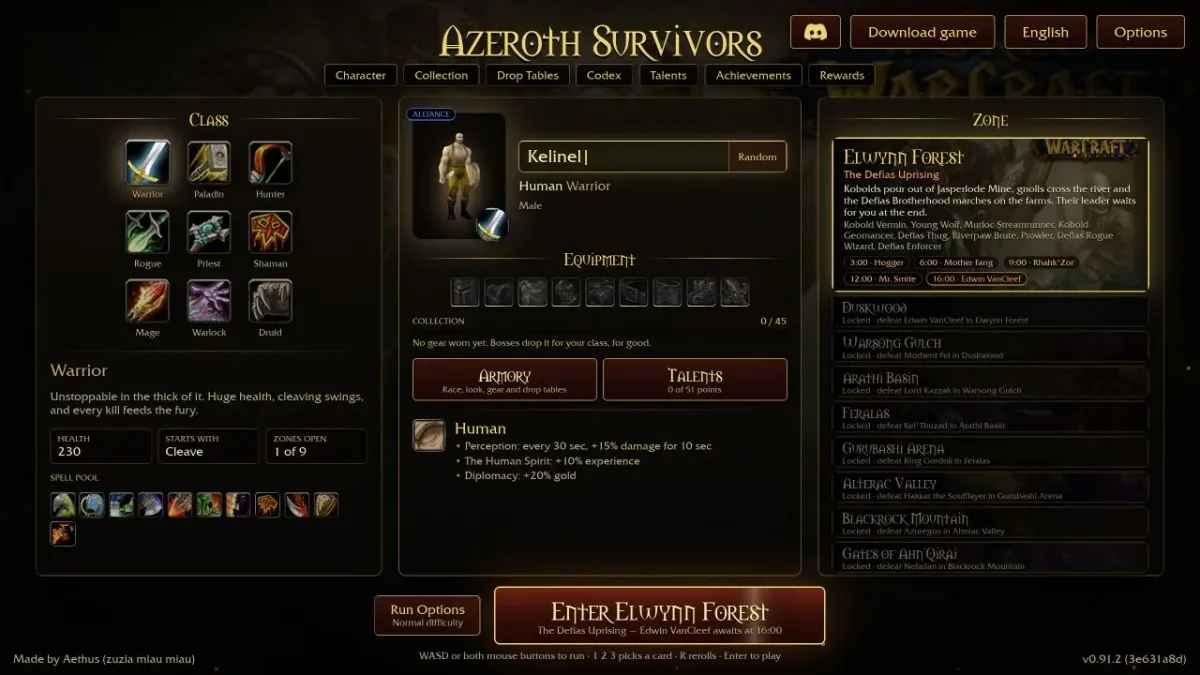
Azeroth Survivors jewelry is the in-run Codex: rings, trinkets and amulets you buy from caches with gold during a run. It is separate from the 498 permanent armory pieces, and none of it carries over when the run ends. Only Armory gear is permanent.
Everything below treats Azeroth Survivors jewelry as what it is: a run-scoped purchase. Gold buys caches, caches roll jewels, and rarity plus rank decide how large each bonus grows. Slot counts, cache price maths and the raw client numbers follow.
What Azeroth Survivors jewelry is (and is not)
The Codex is the game's in-run jewelry system, and its rings, trinkets and amulets are bought from caches with gold.
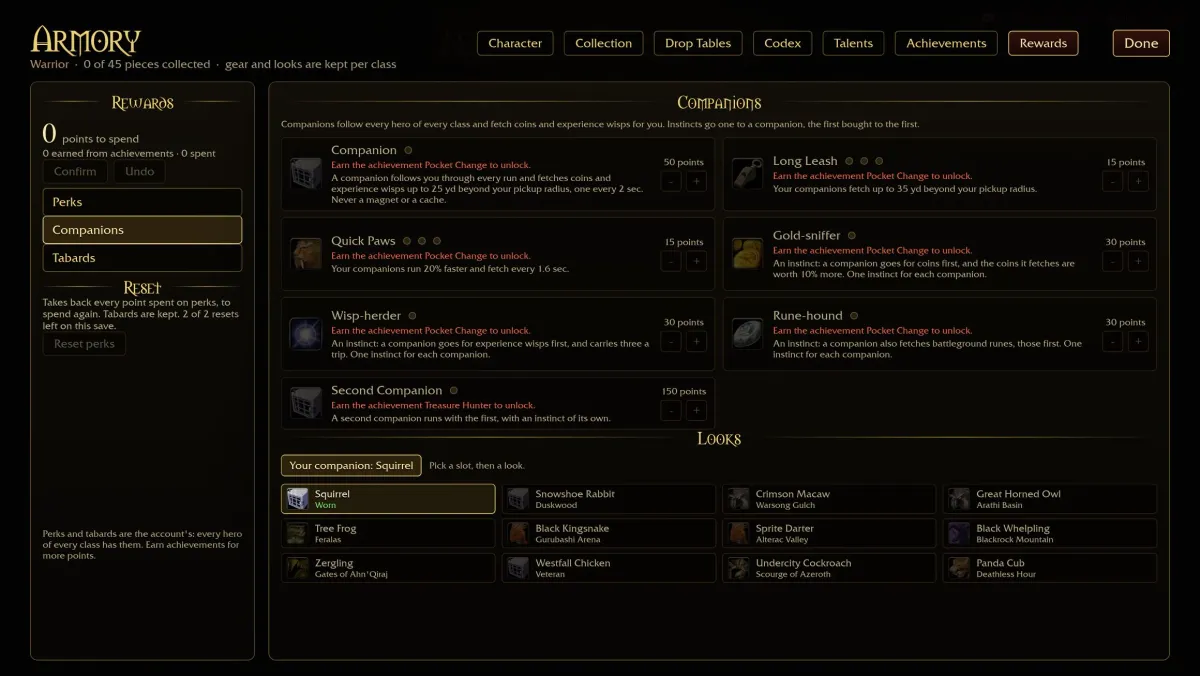
Codex jewelry is explicitly separate from the 498 armory pieces. Those drop from bosses and are equipped between runs, per class, which makes them a different kind of object entirely: one is a run decision, the other is a permanent unlock.
That split decides where you should be reading. If a jewel only exists while a run is live, its numbers belong with the run pages. If you are hunting something that survives the run summary, go to the items wiki or the item sets page instead.
Two rings, two trinkets, one amulet
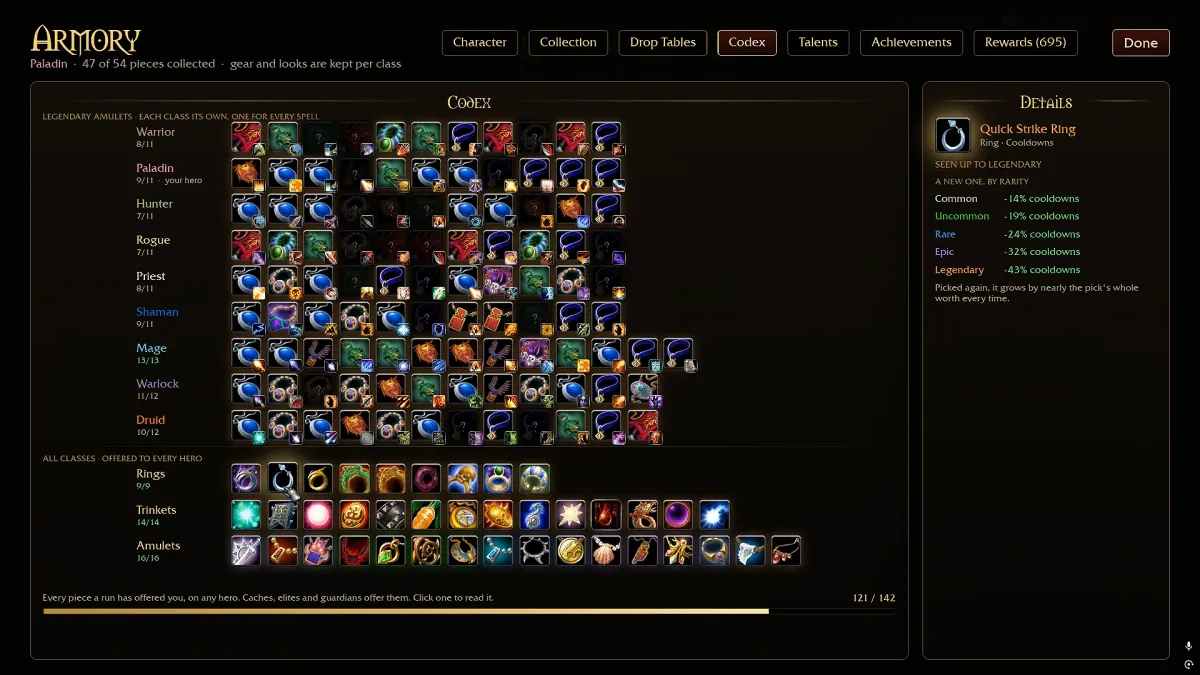
A run gives you 6 spell slots plus two ring slots, two trinket slots and one amulet slot. The spell slots carry the build; the jewelry is trim.
That is five jewels at most, sitting alongside 6 spell slots. Because the level-up offer has no reroll, the jewel card you accept is the one you keep for the rest of the run, so a dead pick costs a slot rather than a second look.
Slot pressure is the real constraint here: with a single amulet slot, a second good amulet is not a second pick, it is a replacement.
Azeroth Survivors jewelry counts, by version
The totals move with the patch, so the version stamp matters more than the headline figure.
| Snapshot | Jewelry entries |
|---|---|
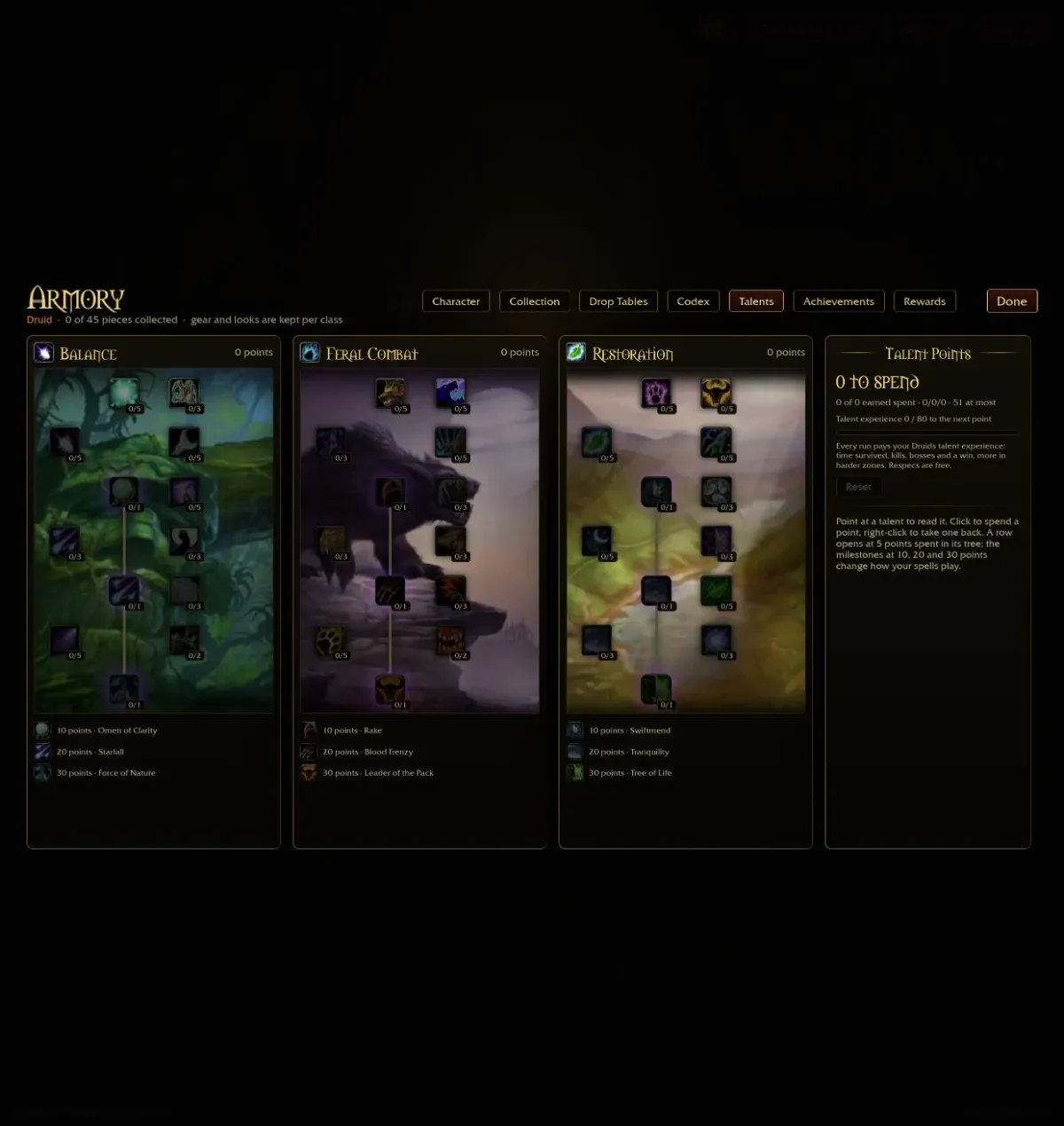
| v0.120.x, Windows client, 2026-10-26 | 142 total = 9 rings + 14 trinkets + 16 general amulets + 103 class spell amulets |
| Items hub listing | 141 run jewelry entries, next to 581 permanent gear pieces |
| Reference table built from current client strings | 23 jewelry records |
The 142 figure is the only fully broken-down total, which is why it is the anchor here: 9 rings, 14 trinkets, 16 general amulets and 103 class spell amulets. The 141 on the items hub is a listing count rather than a slot count, and 23 is simply how many jewelry records the current client strings expose to the reference table.
Boss lairs add a second, smaller pool: 39 jewelry items can appear inside a boss's lair, so the item you meet in a lair is drawn from a narrower set than the full Codex.
Where jewelry comes from: caches and boss lairs
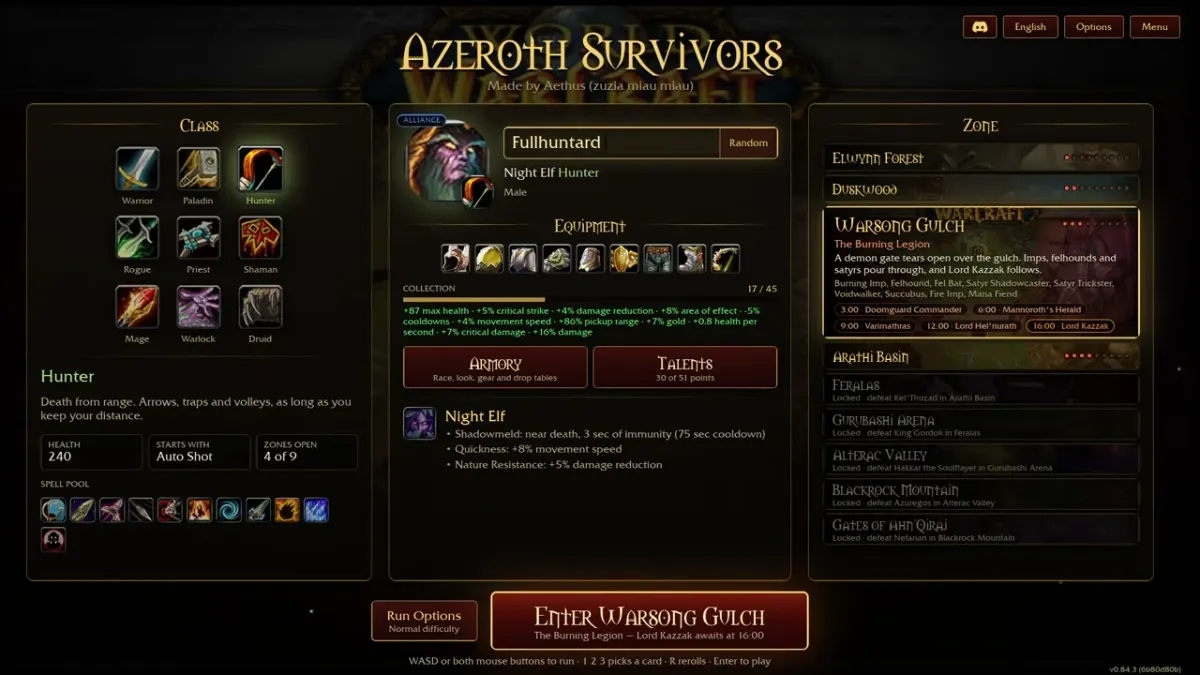
You get jewelry by buying it from caches with gold during a run. That is the Codex route, and it is a purchase rather than a drop.
The second route is the lair pool: 39 jewelry items can appear inside a boss's lair. That pool is narrower than the Codex, so a lair offers fewer distinct jewels than a cache sequence does.
Both routes feed the same five slots. Neither one puts anything into your permanent collection, which is why the bosses wiki and zones pages are worth reading with a single run in mind rather than a long-term plan.
Cache prices and why each buy raises the next
Every battleground cache you buy raises the price of the next one: next price = price × 1.3 + 5, rounded down. The multiplier stays at 1.3, so early buys are cheap and late buys are not.
From Heroic III onward the added amount changes to 6.25 (Lean purse), which makes each later purchase costlier still.
One recorded v0.77.6 run gives a sense of the scale: at 6:25 the Warlock held 113 gold against a 63 gold cache price, so the purchase was still affordable at that point.
Gold does exactly one job in Azeroth Survivors jewelry: it pays for caches, and every purchase raises the next price. That makes caches worth buying while the next price still fits your gold, and questionable once the multiplier has run ahead of your income.
Rarity and rank scaling of jewel values
Azeroth Survivors jewelry values scale with the card rarity you roll: Common 1.0×, Uncommon 1.4×, Tier 0.5 Scholomance, Rare 1.8×, Epic 2.4× and Legendary 3.2×. Legendary is the ceiling at 3.2× the Common value.
Ranks stack on top with diminishing gains. Rank 2 uses 1.6× a jewel's rank-1 values, and re-picking the same jewel up to rank 5 multiplies those rank-1 values by 2.52.
Two rings show what that looks like at the floor. Band of Accuria shows +26% damage at Common quality on first acquisition, and Ring of Spell Power shows +21% area of effect at Common quality on first acquisition.
No page here ranks rings or trinkets against each other, so there is no honest best-in-slot list. The closest supported pick is Band of Accuria, +26% damage at Common, because it is the bigger of the two Common-quality ring numbers recorded here.
Reading stored coefficients from the client
The client stores each jewel as a name, an effect template and a coefficient. The reference table prints that coefficient exactly as stored, with no conversion to a percentage, so the raw float is what you compare.
- Horn of the Warchief: coefficient 2, template "Your buffs are {v}% stronger".
- Ring of the Devoured: coefficient 0.03500000014901161, template "+{v} health per second".
- Band of Accuria: no coefficient printed, because its stored float does not decode as a small coefficient.
The missing Band of Accuria cell is not an error in the table. It means the stored float does not decode as a small coefficient, so printing it would mislead. Everything the table does print is the client's own string or float.
When you compare two jewels, compare the same field: the template text first, then the float. A coefficient of 2 on a percentage template and a coefficient of 0.035 on a per-second template are not on the same scale, and the table does not pretend they are.

What you keep after the run ends
Nothing from the Codex survives. Azeroth Survivors jewelry is an in-run choice, and Armory gear is the permanent system, so the run summary clears your rings, trinkets and amulet along with the spells.
Boss drops do not fix that, and they do not help all your classes either: the 498 armory pieces are per-class drops, so a piece that drops for one class is not a shared unlock for the other eight. Each class's own guide is linked from classes.
Rings, trinkets and amulets therefore all behave the same way after a run: none of them stays. If you want permanent loot instead, read the items wiki and the item sets pages, then check builds and the tier list to see what a class does with it.
One practical consequence: treat Azeroth Survivors jewelry as a per-run budget problem. Slots are fixed at 6 spell slots, 2 rings, 2 trinkets and 1 amulet, cache prices climb by 1.3× plus a flat add with every purchase, and rarity and rank decide whether the jewel is worth the slot it occupies.
FAQ
How do I get Azeroth Survivors jewelry?
Buy it from caches with gold during a run. The Codex has no other acquisition route for rings, trinkets and amulets.
Do I keep Codex jewelry after a run?
No. Codex jewelry does not carry over between runs; only Armory gear is permanent.
What does gold do in Azeroth Survivors?
It pays for caches, and each battleground cache you buy raises the next price by a 1.3 multiplier plus a flat add that becomes 6.25 from Heroic III.
Are caches worth buying?
While the next price fits your gold, yes: in a recorded v0.77.6 run the Warlock held 113 gold against a 63 gold cache price. Once the multiplier outruns your income, the same gold buys less.
Which rings and trinkets are best?
The data does not rank them. Band of Accuria at +26% damage on first acquisition at Common is the strongest number we can point to, and Ring of Spell Power is +21% area of effect.
Does boss gear help all my classes?
No. The 498 armory pieces are per-class drops equipped between runs, so a boss drop belongs to the class that earned it. Nothing in Azeroth Survivors jewelry or armory loot is shared across all nine classes as one unlock.
Counts, prices and coefficients reflect the client strings and version stamps shown in the tables above; run totals shift between patches, and unverified details are left out rather than guessed.