Azeroth Survivors Builds: All 9 Classes Side by Side
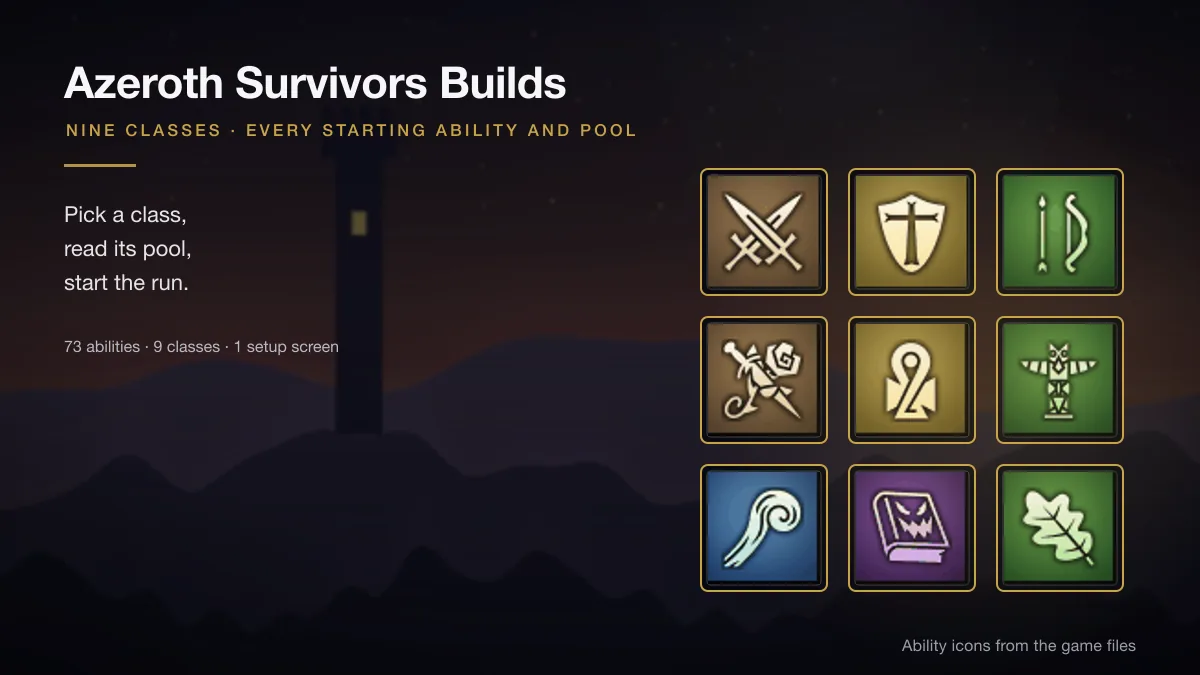
Updated 2026-11-19.
Version 0.145.2 client (checked 2026-11-20); value tables last verified on 0.143.3, 2026-11-12.
Azeroth Survivors builds come down to nine classes, and each one starts with its own skill and draws upgrades from its own pool. This page puts all nine side by side: starting skill, pool size, power type and the numbers behind it, last verified on 0.143.3 (2026-11-12); the client now reports 0.145.2 (checked 2026-11-20).
What do Azeroth Survivors builds look like at a glance?
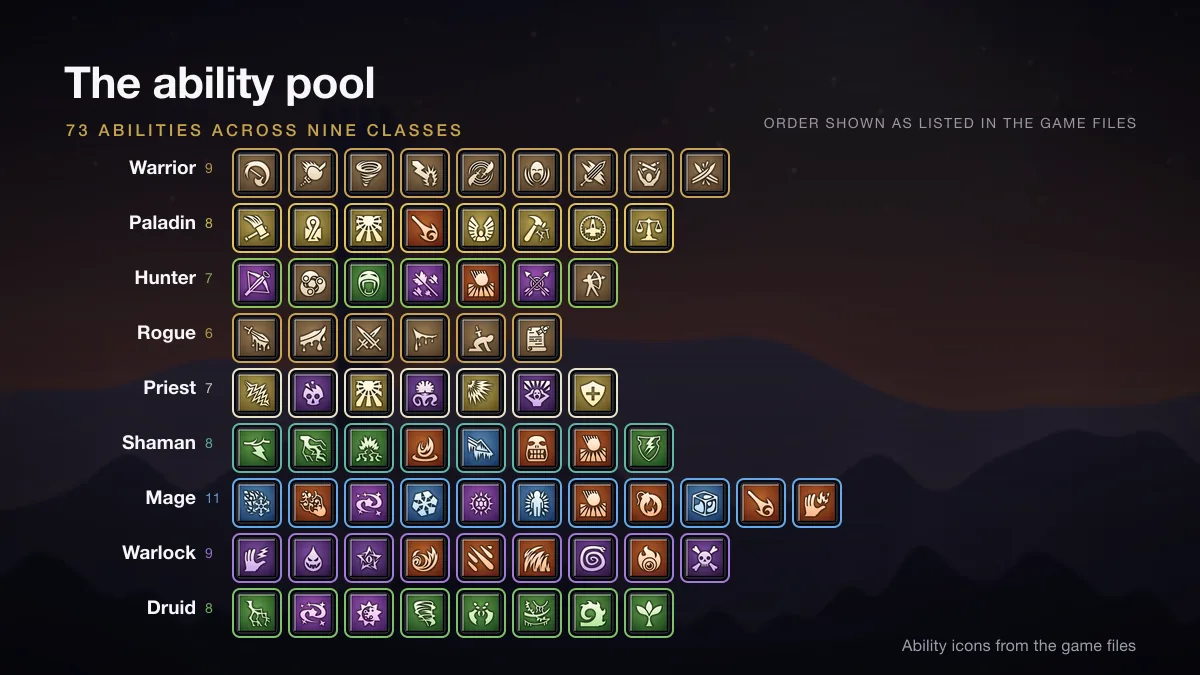
Every one of the nine Azeroth Survivors builds is one class, one starting skill and one pool of class skills. The table below lists all nine with the numbers that matter before a run: what the class starts with, how big its pool is, which skills sit in that pool and which resource the class table gives it.
The data on this page does not give race or zone modifiers, and it covers Azeroth Survivors builds rather than WoW Survivors builds.
| Class | Starting skill | Starting skill type | Class skills in the pool | Pool mix | Power type |
|---|---|---|---|---|---|
| Warrior | Cleave | Melee | 9 | 3 melee, 3 nova, 1 aura, 1 strike, 1 thorns | Rage |
| Paladin | Hammer Of Wrath | Bolt | 8 | 4 strike, 1 bolt, 1 nova, 1 ground self, 1 immune | Mana |
| Hunter | Arcane Shot | Bolt | 7 | 5 bolt, 2 ground | Mana |
| Rogue | Sinister Strike | Melee | 6 | 4 melee, 1 nova, 1 damage over time | Energy |
| Priest | Smite | Strike | 7 | 3 strike, 2 nova, 1 damage over time, 1 shield | Mana |
| Shaman | Lightning Bolt | Bolt | 8 | 3 strike, 2 totem, 1 bolt, 1 chain, 1 orbit | Mana |
| Mage | Frostbolt | Bolt | 11 | 4 bolt, 3 nova, 2 ground, 1 strike, 1 cone | Mana |
| Warlock | Shadow Bolt | Bolt | 9 | 3 strike, 2 bolt, 2 damage over time, 1 ground, 1 aura | Mana |
| Druid | Wrath | Bolt | 8 | 2 strike, 2 damage over time, 1 bolt, 1 ground, 1 thorns, 1 heal | Mana |
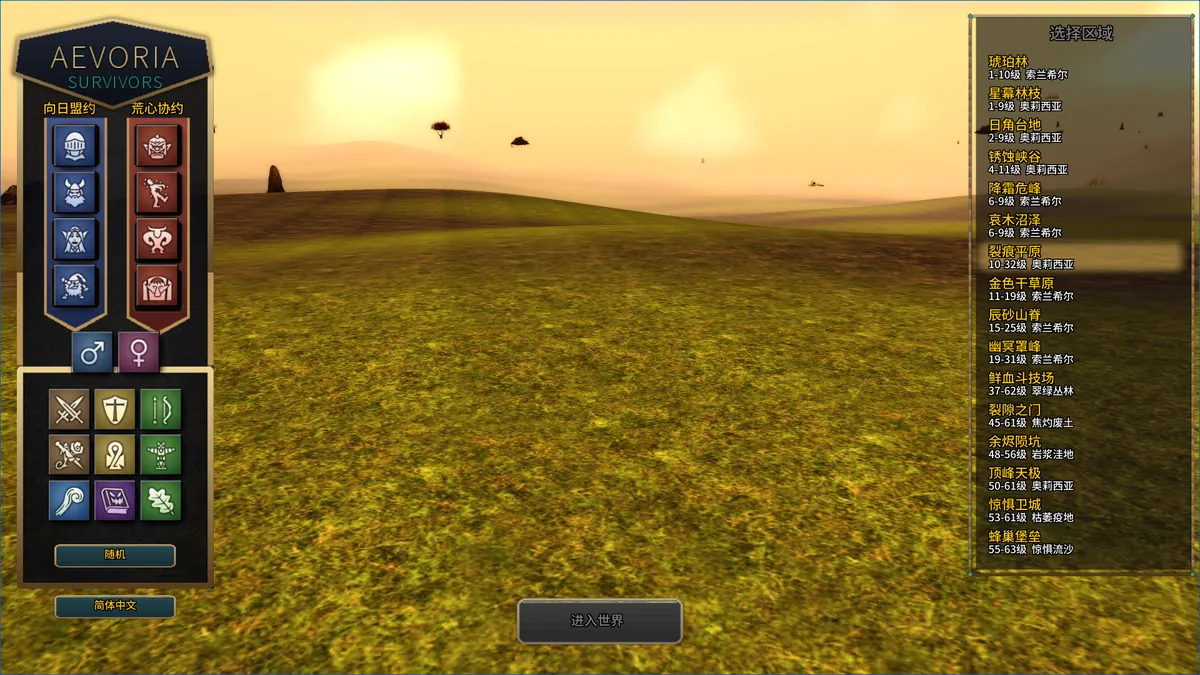
Screenshot of the browser game
| How to read this table | Value |
|---|---|
| Classes listed | 9, one row each |
| Counting rule | Pool = the class's own skill list; the starting skill is counted in it |
| Skill types | The kind tag the game gives each skill in that class's list |
| Data version | 0.143.3, latest record 2026-11-12 |
| Last updated | 2026-11-14 |
Each class has its own build page with the full skill list:
- Warrior build: Cleave and 9 class skills.
- Paladin build: Hammer Of Wrath and 8 class skills.
- Hunter build: Arcane Shot and 7 class skills.
- Rogue build: Sinister Strike and 6 class skills.
- Priest build: Smite and 7 class skills.
- Shaman build: Lightning Bolt and 8 class skills.
- Mage build: Frostbolt and 11 class skills.
- Warlock build: Shadow Bolt and 9 class skills.
- Druid build: Wrath and 8 class skills.
For the beginner side of the same choice, read the classes and beginner builds guide; for waves, pickups and the level-up loop, read how to play Azeroth Survivors. Every row in the quick table has a page of its own below it, so the nine Azeroth Survivors builds can be compared one class at a time. The tier list rates the nine classes on ease of play, survival and damage.
For the best build on each class, open the Warrior, Paladin, Hunter, Rogue, Priest, Shaman, Mage, Warlock and Druid pages; the game data does not rank the nine, so each page gives the supported pick for that class.
The table values are last verified on 0.143.3, latest record 2026-11-12, per the patch notes; the client file now reports 0.145.2 (checked 2026-11-20). skill, talent, equipment and boss values are unchanged for that release.
How do you pick your first Azeroth Survivors build?
Pick the class whose starting skill you want to watch for a whole run, then check two numbers: its reach and its pool size. The starting skill is the only ability you own from the first second, so it sets how the opening waves feel, and reach decides whether you stand inside the pack or keep a gap open.
For a first run, Rogue with 6 class skills is the gentlest pool, then Hunter and Priest with 7, while Warrior is the safest melee pick because Cleave hits three targets.
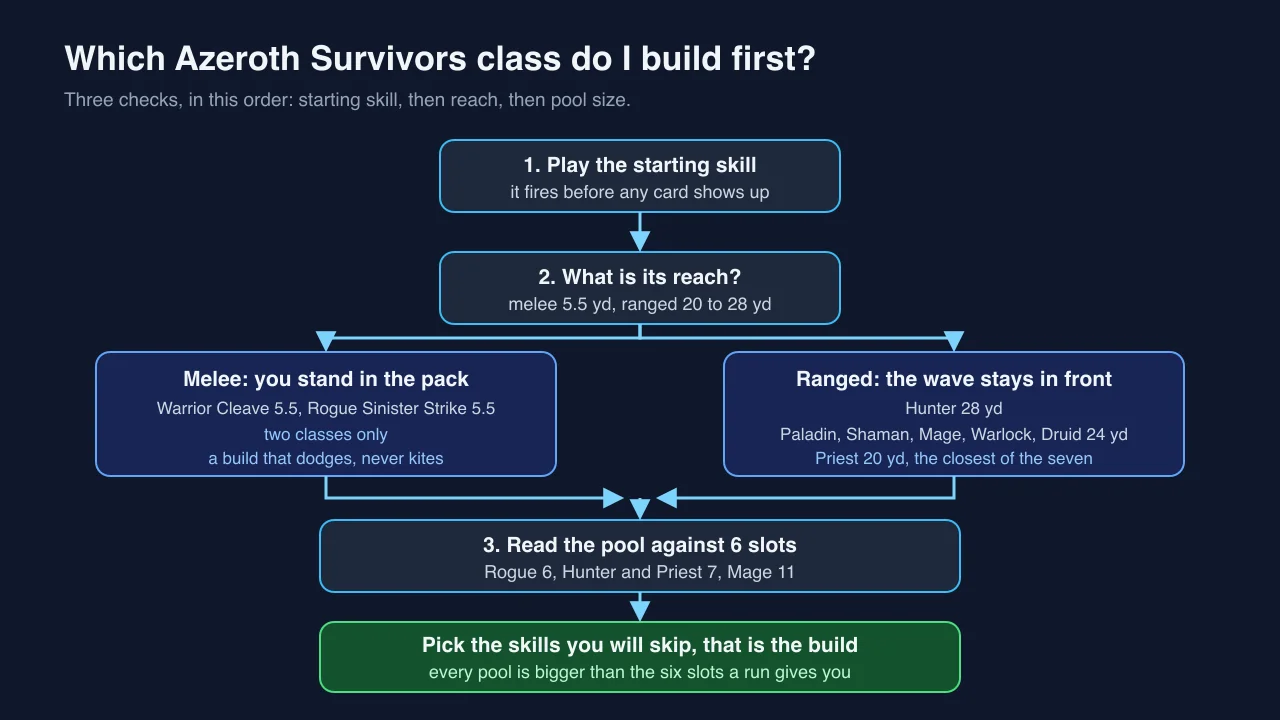
Diagram based on game data
- Play the starting skill first, because it fires before any level-up card appears and it is what clears the opening wave on every class.
- Check the reach next, because Cleave and Sinister Strike hit at 5.5 yards while the ranged starters sit between 20 and 28, and that distance decides where you stand for the rest of the run.
- Count the pool after that, because Rogue offers 6 class skills and Mage offers 11 against the same 6 slots, so a bigger pool means more cards that will not fit any build.
- Decide which skills you will skip before the run, because every pool is larger than the slots a run gives you and a build is defined as much by what it leaves out as by what it takes.
None of that needs a tier list: the nine Azeroth Survivors builds differ in starting skill, reach and pool size, and all three numbers are printed above, so the pick comes down to which pool you want to learn rather than to which hero looks strongest in someone else's run.
How hard does each class's starting skill hit?
Every class starts with one skill at level 1, and the ability table gives that skill its damage, cooldown, range and target count. Damage is what one cast deals before any passive card, cooldown is how often it fires again, and range is the distance the game checks before the skill picks its target.
Warrior starts with Cleave, Paladin with Hammer Of Wrath, Hunter with Arcane Shot, Rogue with Sinister Strike, Priest with Smite, Shaman with Lightning Bolt, Mage with Frostbolt, Warlock with Shadow Bolt and Druid with Wrath.
| Class | Starting skill | Damage per cast | Cooldown | Range | Targets per cast |
|---|---|---|---|---|---|
| Warrior | Cleave | 14 | 1.1 s | 5.5 yd | 3 |
| Paladin | Hammer Of Wrath | 16 | 1.5 s | 24 yd | 1 |
| Hunter | Arcane Shot | 13 | 1.0 s | 28 yd | 1 |
| Rogue | Sinister Strike | 15 | 0.85 s | 5.5 yd | 1 |
| Priest | Smite | 14 | 1.2 s | 20 yd | 1 |
| Shaman | Lightning Bolt | 15 | 1.3 s | 24 yd | 1 |
| Mage | Frostbolt | 12 | 1.3 s | 24 yd | 1 |
| Warlock | Shadow Bolt | 15 | 1.4 s | 24 yd | 1 |
| Druid | Wrath | 13 | 1.2 s | 24 yd | 1 |
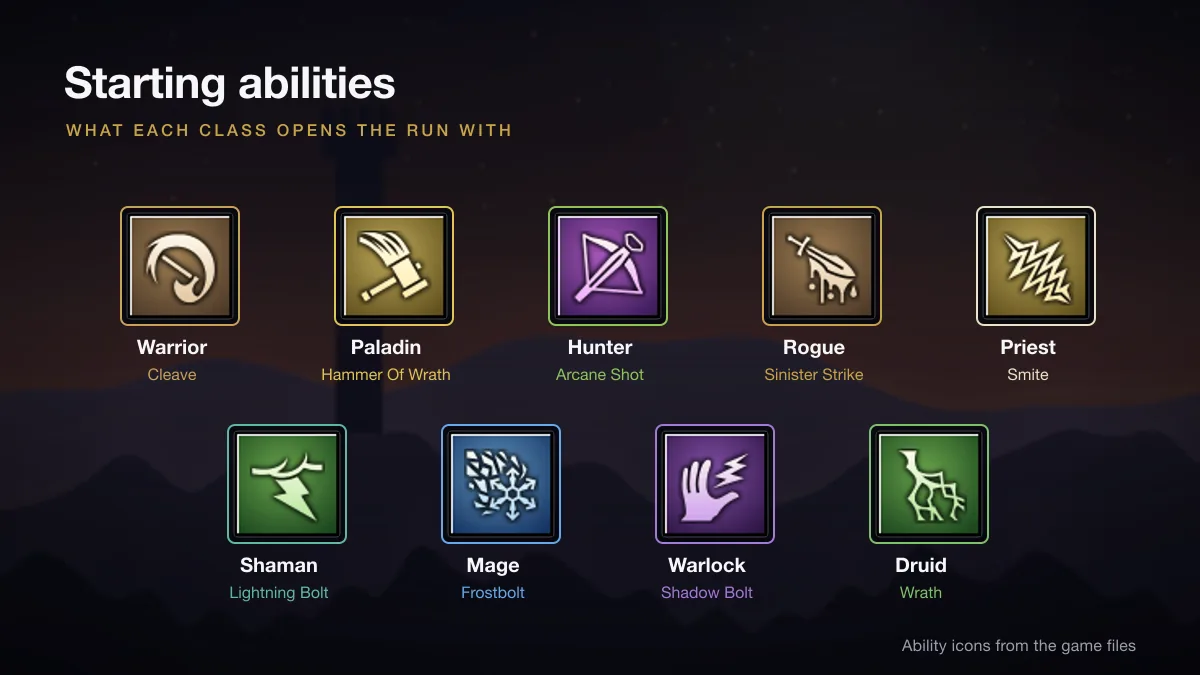
Ability icons from the game files
Those are level 1 casts. Every level adds 30% of the base damage, so a level 8 skill deals 3.1 times its base damage, its cooldown shrinks by 7% per level, and it picks up one extra target at levels 3, 5 and 7, which is how a three target Cleave becomes a six target Cleave.
Push two or three active skills high instead of spreading levels: a level 8 skill deals 3.1 times its base damage, while a level 1 extra skill adds little. Split the six actives as two or three damage skills plus one or two coverage slots, and let passives such as Power Word: Fortitude and Mark of the Wild carry survival in the final minutes. For swarm clearing versus the final boss, the answer for a specific class stays inside that class's own pool: Warrior uses nova, aura and thorns against swarms and melee and strike against the boss; Paladin uses nova and ground self against swarms and strike and bolt against the boss; Hunter uses ground against swarms and bolt against the boss; Rogue uses nova and damage over time against swarms and melee against the boss; Priest uses nova and damage over time against swarms and strike against the boss; Shaman uses totem, chain and orbit against swarms and strike and bolt against the boss; Mage uses nova, ground and cone against swarms and bolt and strike against the boss; Warlock uses damage over time, ground and aura against swarms and strike and bolt against the boss; Druid uses damage over time, ground and thorns against swarms and strike and bolt against the boss. Because every pick sits in the class's own pool, these Azeroth Survivors builds never need an out-of-class skill, and each class page lists the full pool behind the pick.
How do Azeroth Survivors builds fill their six skill slots?
A run holds six skills, each skill reaches level 8, and six passives fill the side slots, so a build is a whole-run plan rather than a collection of picks. Each level offers three cards, and the offer weighs them: an upgrade to a skill you already own comes up most often and a brand new passive least often.
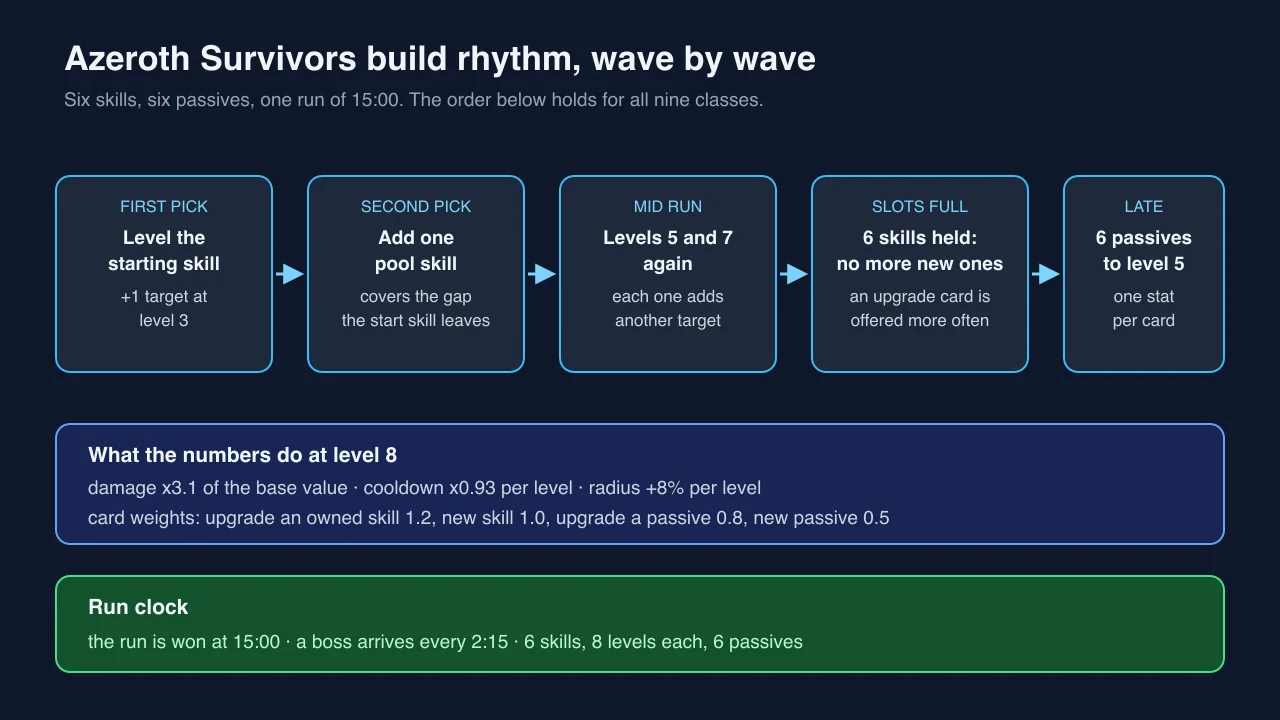
Diagram based on game data
The weight is why an early pick matters more than it looks in Azeroth Survivors builds. Upgrading a skill you hold is offered at weight 1.2, a new class skill at 1.0, a passive upgrade at 0.8 and a new passive at 0.5, so the skill you take on the first card is also the one the game keeps pushing higher.
The game itself has no in-run build planner or shareable build code, and the patch notes are the only version signal, so copy this class-agnostic pick order:
- Start with the class starting skill and take its upgrades until it reaches level 8.
- Add one class skill from your pool that covers the opener's reach or area gap, and push it to level 8 second.
- Add a third damage skill only when the first two are near level 8 or wave clear falls behind.
- Use the remaining active slots for coverage against swarms or the final boss, not six skills at level 1.
- Fill passive slots after two or three actives are set: Amplify Magic for area skills and Arcane Intellect for recharge.
- Add Power Word: Fortitude or Mark of the Wild when hits start hurting, and level the stat your build already uses.
- When a wanted card is not offered, take the best upgrade to a skill you already hold; there are no rerolls.
| Rule | Value |
|---|---|
| Skills held at once | 6 |
| Levels per skill | 8 |
| Passives held at once | 6 |
| Levels per passive | 5 |
| Run clock | 15:00, and the run is won at the clock |
| Boss timer | one boss every 2:15 |
Push two or three active skills high instead of spreading levels: a level 8 skill deals 3.1 times its base damage, while a level 1 extra skill adds little. Split the six actives as two or three damage skills plus one or two coverage slots, and let passives such as Power Word: Fortitude and Mark of the Wild carry survival in the final minutes. For the best build on each class, use that same shape and fill it from the class's own pool: Warrior Cleave plus a nova or aura skill, Paladin Hammer Of Wrath plus a strike or nova, Hunter Arcane Shot plus a ground skill, Rogue Sinister Strike plus a nova or damage-over-time skill, Priest Smite plus a nova or damage-over-time skill, Shaman Lightning Bolt plus a totem, chain or orbit skill, Mage Frostbolt plus a nova or ground skill, Warlock Shadow Bolt plus a damage-over-time, ground or aura skill, and Druid Wrath plus a damage-over-time, ground or thorns skill, with the starting skill at level 8 first. For swarm clearing versus the final boss, pair the same starting skill with the opposite pool type: use nova, ground, chain, aura or thorns skills for swarms, and strike, bolt or melee skills for the boss, so a class never needs skills outside its own pool. These are the supported Azeroth Survivors builds; each class page lists the full pool behind the pick.
Which passives can an Azeroth Survivors build take?
Passives are not split by class in Azeroth Survivors builds. All nine classes draw from the same ten passive cards, hold six of them and level each one to 5, so a Warrior and a Mage are offered the same list. Every card raises one stat by a fixed amount per level, and none of them is class locked.
| Passive card | Stat | What it raises | Per level |
|---|---|---|---|
| Blessing of Might | Might | All damage you deal | +10% |
| Power Word: Fortitude | Max health | Maximum health | +20% |
| Aspect of the Pack | Speed | Movement speed | +10% |
| Renew | Regen | Health restored per second | +0.5 per second |
| Arcane Intellect | Haste | How fast abilities recharge | +8% |
| Amplify Magic | Area | Size of your areas of effect | +10% |
| Detect Lesser Invisibility | Magnet | Pickup range | +40% |
| Blessing of Wisdom | Growth | Experience you gain | +8% |
| Mark of the Wild | Armor | Damage blocked per hit | +1 per hit |
| Blessing of Kings | Crit | Chance to crit for double damage | +5% |
Ability icons from the game files
Because the pool is shared by all nine Azeroth Survivors builds, a class never changes which passives you are offered, so the choice is about the stat your run is short of rather than about the hero. Amplify Magic is the card that grows every area and damage-over-time skill in a pool, and Arcane Intellect is the one that makes a whole build fire more often.
Luck is not in this ten-card passive table, so the page cannot assign it a build role; the supported passives are the ten listed above. Take Amplify Magic when area skills carry the clear and Arcane Intellect when the build needs recharge; Power Word: Fortitude and Mark of the Wild are the survival picks when hits start hurting.
What mistakes stall an Azeroth Survivors build?
Most runs end on a build decision rather than on a class being weak, and the same six mistakes show up across Azeroth Survivors builds. Each one wastes a card, a slot or the open space a build needs, and all six can be fixed inside a single run.
Late-run stalls changed with Hyper Mode in 0.143.0: with Hyper on, final-boss thresholds move to 8, 9 or 10 minutes instead of 16, 18 or 20, base guardian respawns drop to 90 seconds on Normal and Heroic I and 75 seconds on Heroic II–V, and Endless bosses return every 2:30 instead of every 5:00. In co-op, if the run is waiting only on one player's cards, the game picks the first card after 120 seconds.
- Taking a new skill at every level-up and leaving the starting skill at level 2 or 3, when that first skill is the one the offer keeps upgrading.
- Treating a big pool as an advantage: Mage offers 11 class skills and a run holds 6, so 5 of them will never make the build.
- Filling all six passive slots with level 1 cards instead of levelling the cards already in the build.
- Picking a class for its passive list, when all nine classes are offered the same ten cards.
- Judging a class on one run, when one run only shows part of its pool and the rest never got offered.
- Standing still because the skills aim themselves, when the auto-cast handles aiming and not positioning.
Screenshot of the browser game
Azeroth Survivors Builds FAQ
How many Azeroth Survivors builds are there?
There are nine, one per class: Warrior, Paladin, Hunter, Rogue, Priest, Shaman, Mage, Warlock and Druid. Each class has its own starting skill and its own pool of class skills, which runs from 6 on the Rogue to 11 on the Mage.
Which Azeroth Survivors builds are easiest for a first run?
A short pool and a readable starting skill make the opening easier, so Rogue with 6 class skills, then Hunter and Priest with 7, are the gentlest lists to learn. Warrior is still a fine first class, because Cleave hits the three closest enemies in melee reach and shows you spacing from the first second.
What is the current Azeroth Survivors game version?
The client file that the game host serves reports 0.145.2 (checked 2026-11-20). The newest patch notes entry recorded here is 0.143.3, latest record 2026-11-12; skill, talent, equipment and boss values are unchanged for that release. Final-boss thresholds now 8, 9 or 10 minutes, base guardian respawns drop to 90 seconds on Normal and Heroic I and 75 seconds on Heroic II–V, Endless bosses return every 2:30, and Hyper Mode timings are unchanged.
How do co-op changes affect Azeroth Survivors builds?
In co-op, Battle Shout gives allies the caster’s Horn of the Warchief and Bloodlust bonuses, but an ally’s own horn no longer strengthens another player’s shout. Co-op requires version 0.143.1 and the ready check lasts 30 seconds; if the run waits only on one player's cards, the game picks the first card after 120 seconds.
Is there one strongest class in Azeroth Survivors builds?
The class data does not rank the nine heroes; it gives each one a starting skill, a pool size and a type mix, and those are the only things that differ between them. What you can compare is reach and pool shape: Rogue leans on 4 melee skills, Hunter leans on 5 bolt skills, and Mage spreads 11 skills across 4 bolts, 3 novas and 2 ground areas; the tier list page rates ease of play, survival and damage.
Can a build hold every skill its class offers?
No. A run holds 6 skills and every pool is bigger than that, which holds for all nine Azeroth Survivors builds: from 6 on the Rogue to 11 on the Mage, so at least one skill is always left out and the Mage leaves out five. Choosing those skills is the build decision, and each class page lists the full pool so the skips can be planned before the run.
How high can one skill go?
Every skill caps at level 8 and every passive at level 5, with six of each held at once. Each level adds 30% of the skill's base damage, so a finished skill deals 3.1 times its base damage, and it gains one extra target at levels 3, 5 and 7.
Do the classes get different passives?
No. Passives come from one shared pool of ten cards, so all nine classes are offered Blessing of Might, Power Word: Fortitude, Amplify Magic and the other seven. You can hold six and level each to 5, which means a passive card is never a reason to pick one class over another.
Why does an Azeroth Survivors build stop killing things late in the run?
Usually because the cards went into too many different skills. A run is won at 15:00 with a boss every 2:15, so late waves need two or three skills at high level plus Amplify Magic for area size and Arcane Intellect for recharge, not six skills at level 1. The 0.143.3 patch moves final-boss thresholds to 8, 9 or 10 minutes, which makes that focus matter sooner for Azeroth Survivors builds.
Data: the game's own class, ability and passive tables at version 0.143.3 (latest record 2026-11-12); checked 2026-11-14. Independent guide for Azeroth Survivors builds.
Related builds
More Survivors-like Games

D2 Survivors Survivors-like

Archer: Dungeon Hero Roguelike

Dreamland Survivors Survivor
Free in the browser, like the Azeroth Survivors builds guide above.